The first bite is a mistake. Everyone makes it.
You take a hotteok out of the paper cup, it’s the size of your palm, golden, and you bite straight into the middle. What comes out is brown sugar that has been sitting in hot oil for two minutes and is now, functionally, lava.
Every Korean has burned the roof of their mouth this way. It’s part of the food.
Hotteok (호떡) — say it HO-dduk. A yeasted pancake stuffed with brown sugar, cinnamon and crushed nuts, pressed flat on an oiled griddle until the outside crisps and the filling turns to syrup. About ₩2,000, or a dollar fifty.
What’s actually inside
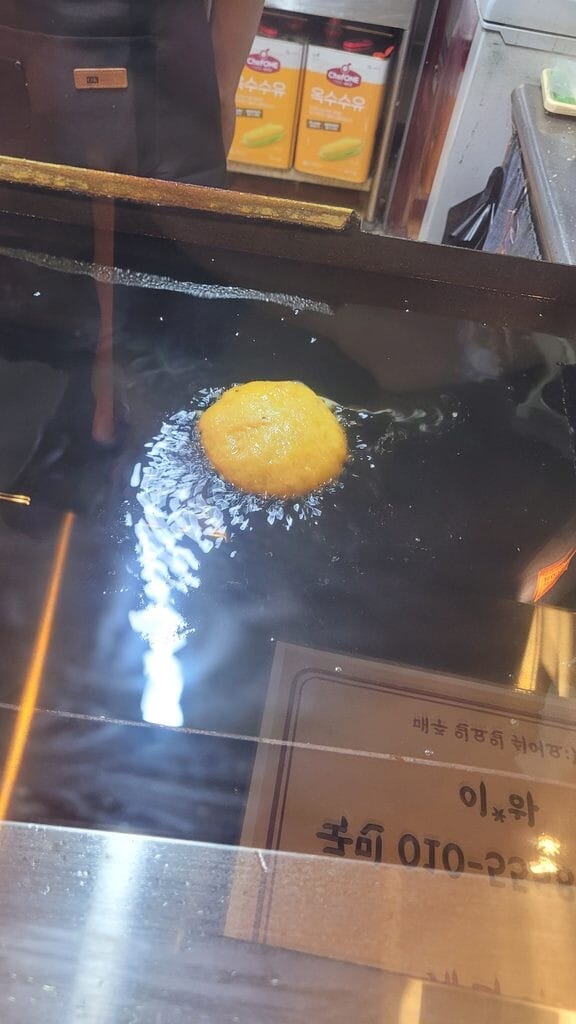
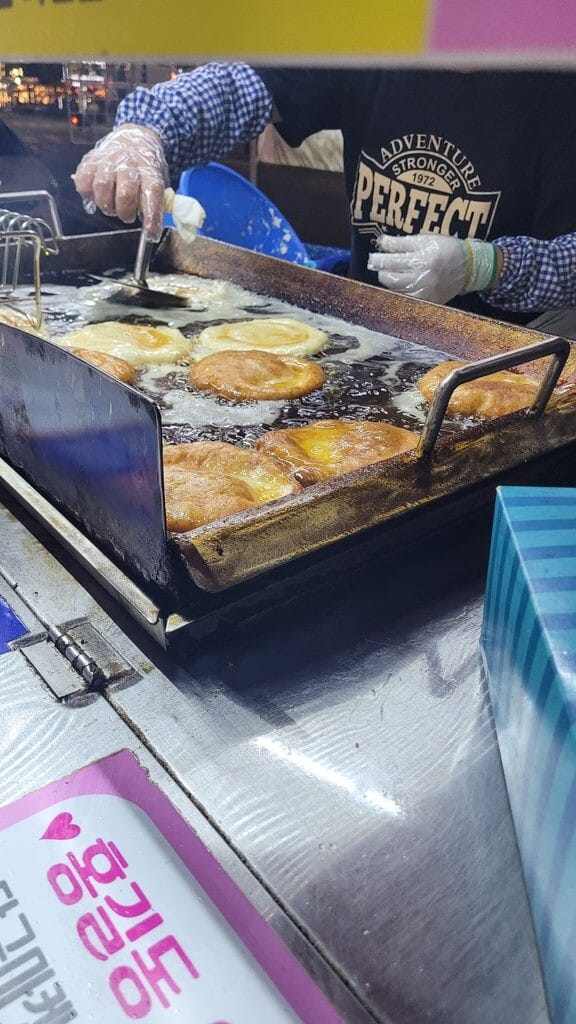
The dough is simple — flour, water, yeast, a little sugar, left to rise. The stalls in these photos advertise 찹쌀 (chapssal), glutinous rice flour, which is the version most people prefer. It makes the dough chewier, stretchier, closer to mochi than to bread.
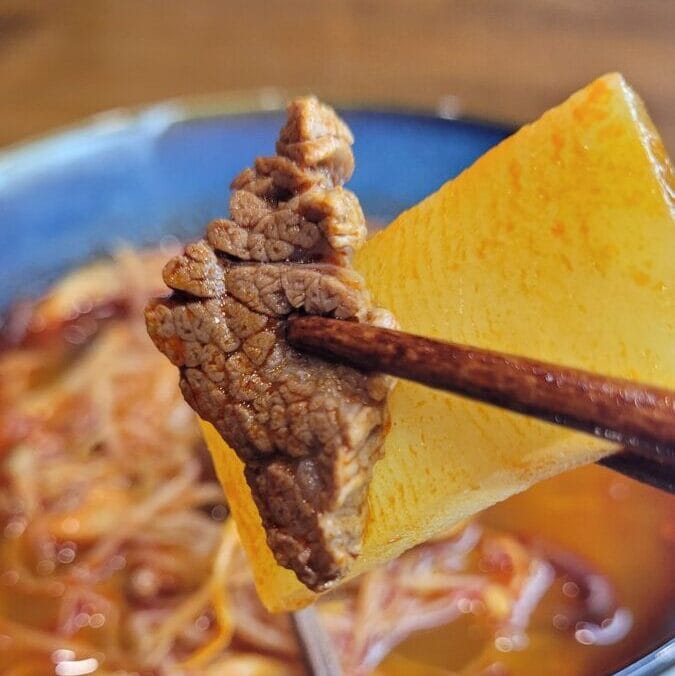
The filling goes in as a dry mix: dark brown sugar, cinnamon, and crushed peanuts or sunflower seeds. You can see them in the photos, suspended in the syrup. The dough is sealed around it, dropped on a hot oiled griddle, and pressed flat with a round tool.
That pressing is the whole technique. It flattens the ball into a disc, forces the filling out toward the edges, and the sugar melts into syrup while the outside fries.
It isn’t baked and it isn’t quite deep-fried — it sits in a shallow pool of oil and cooks on both sides. The outside ends up crisp and slightly blistered; the inside stays soft.
How to eat it without hurting yourself
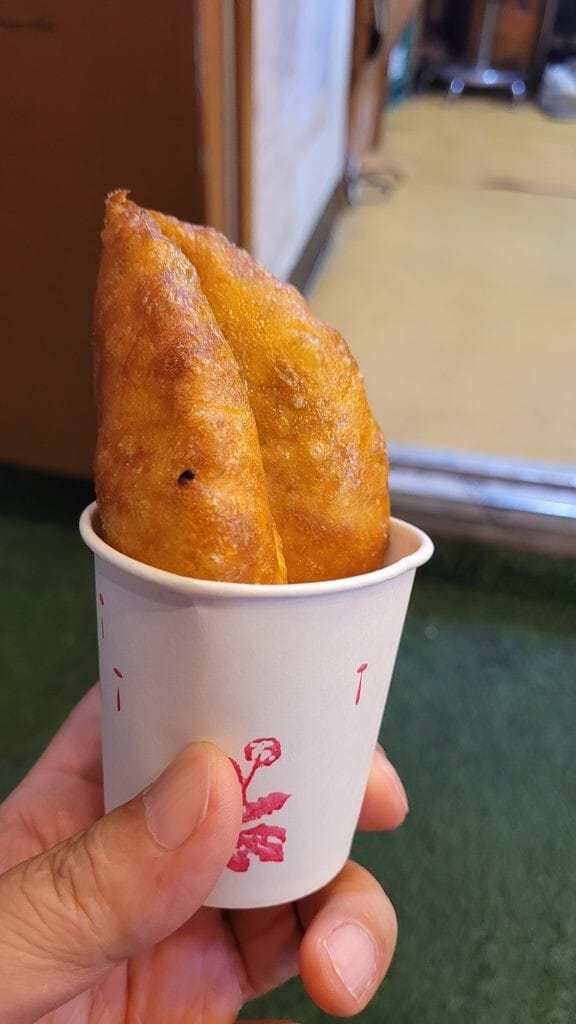
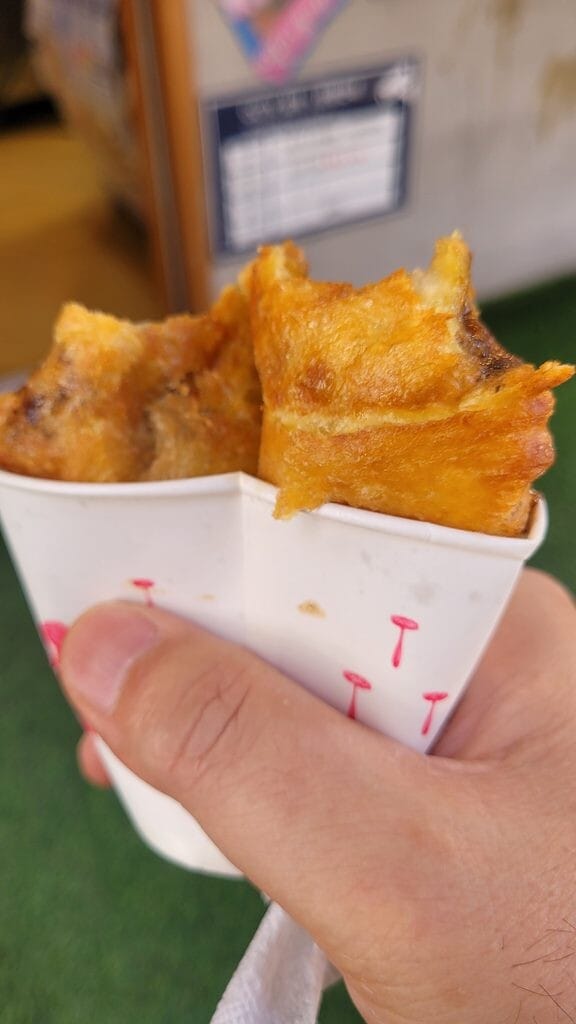
Take this seriously. Molten sugar holds heat far longer than you’d expect.
Bite the edge first. The rim has less filling. This buys you thirty seconds.
Let the steam out. Tear a small opening and wait. You’ll see it steam.
Hold the cup underneath. It gets served folded into a paper cup for exactly this reason — the syrup runs. Keep the cup under your chin and eat over it.
Two minutes of patience. It’s still hot in the middle long after the outside has cooled.
Where you find them

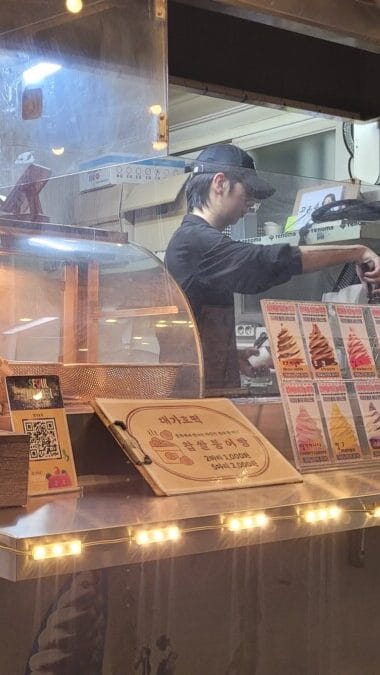
Hotteok is winter food. Carts appear when the weather turns and thin out in warm months. It’s the thing you buy with cold hands on the way home.
You’ll see it three ways:
Storefront stalls — a permanent window on a shopping street, often selling soft-serve and bungeoppang (fish-shaped pastries) alongside. One of these sold bungeoppang at ₩1,000 for two, which tells you how cheap this category runs.
Truck carts — a converted pickup that parks on a corner, sets up a griddle and a light board, and works the evening rush. The one in these photos had a line of students with instrument cases waiting for hotteok at night.
Market stalls — traditional markets, especially in winter.
Prices barely move: ₩2,000 for one, ₩5,000 for three, ₩10,000 for six. Cash or transfer; many carts don’t take cards.
The truck named after a folk hero
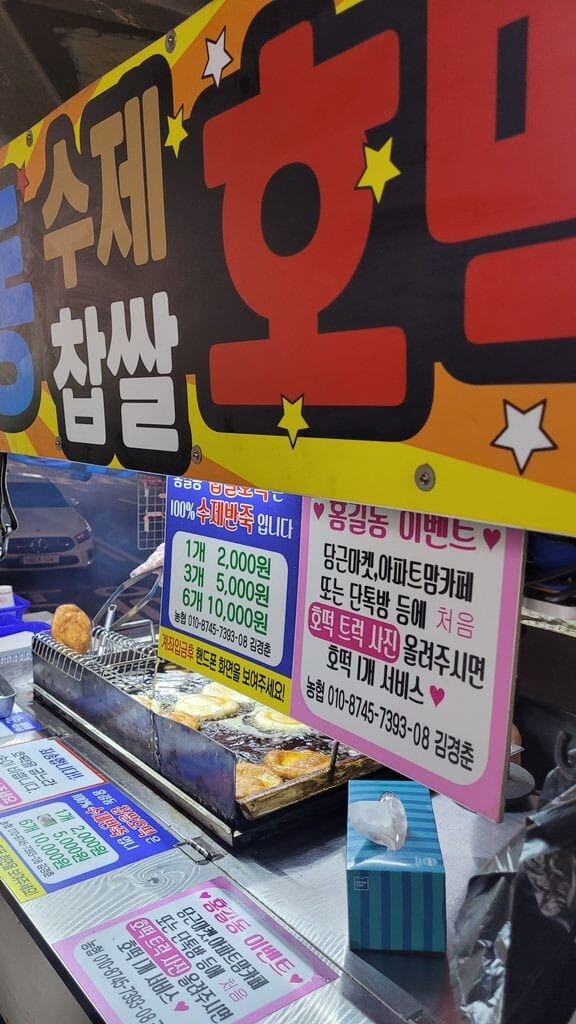
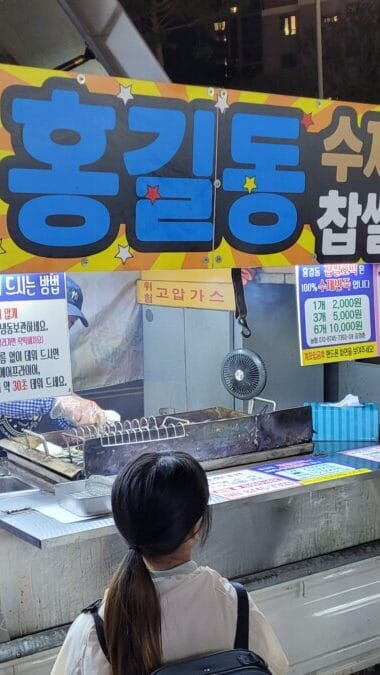
The cart in these photos calls itself Hong Gildong Handmade Chapssal Hotteok.
Hong Gildong is the hero of a 17th-century Korean novel — an outlaw who robbed corrupt officials, roughly Korea’s Robin Hood. His name is also used the way English uses “John Doe,” as the placeholder name on sample forms.
The banner reads: “Flashes in the East Sea! Flashes in the West Sea!” — a line describing how Hong Gildong could appear anywhere, instantly, on opposite ends of the country.
It’s a joke about being a truck. The cart moves around, so it named itself after the folk hero famous for turning up everywhere at once.
Two other signs on the same truck are worth knowing about.
A reheating guide. Printed instructions telling you how to keep leftovers: seal in a freezer bag and freeze, reheat in a dry pan with no oil, or thirty seconds in the microwave. A street cart giving you after-care instructions for a $1.50 snack is a very Korean thing.
A promotion. Post a photo of the truck to your neighborhood community — Daangn Market (Korea’s hyperlocal app, a bit like Nextdoor crossed with Craigslist), an apartment-complex parents’ café, or a group chat — and get a free hotteok.
That’s the entire marketing budget. No ads, no platform. Just: tell your neighbors where the truck is parked tonight.
Things to know before you order
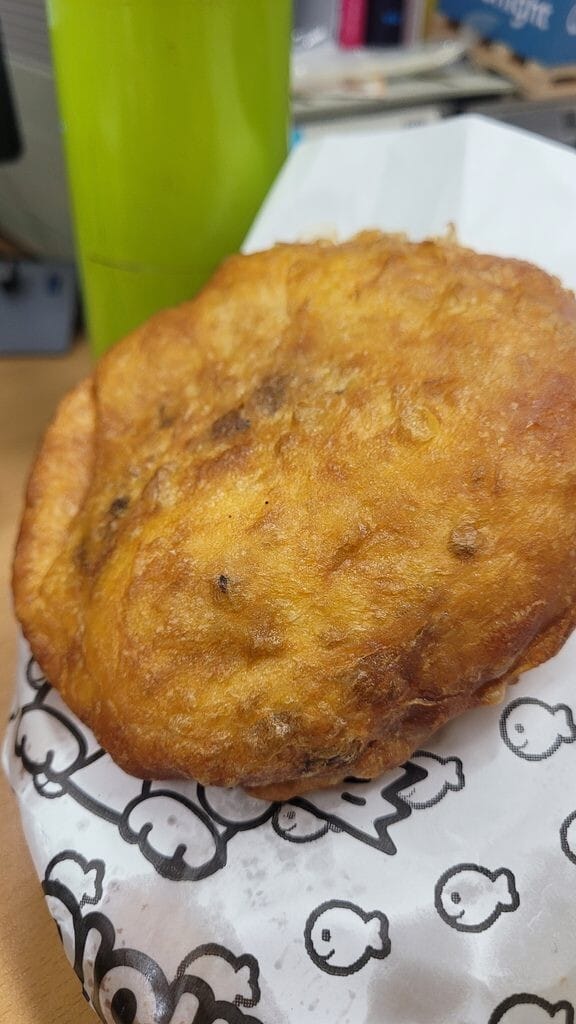
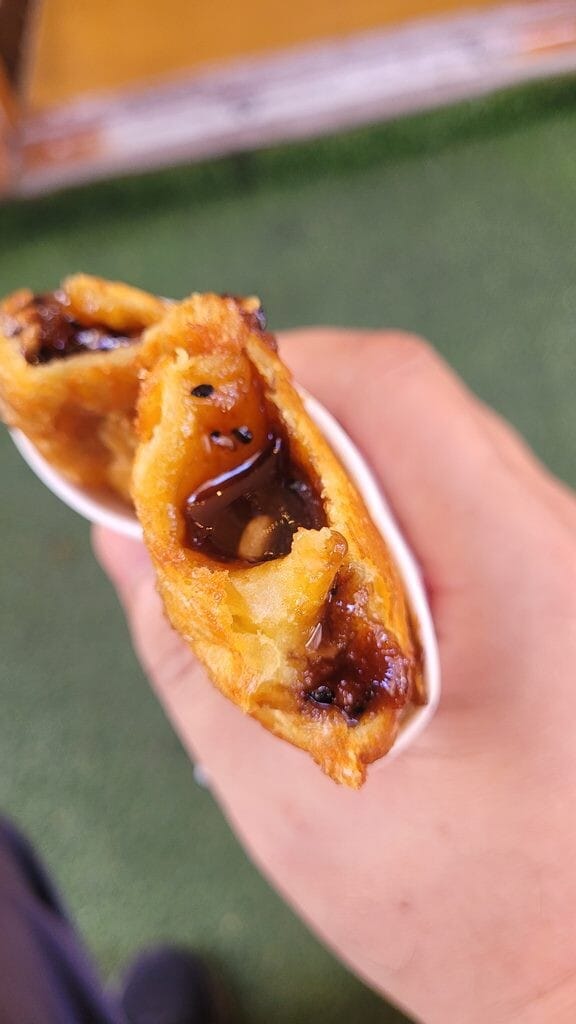
Ask for 찹쌀 (chapssal). If both are available, the glutinous rice version is chewier and generally better.
Savory versions exist. Some stalls sell japchae hotteok, filled with glass noodles and vegetables instead of sugar. Busan’s version, ssiat hotteok, gets cut open and packed with seeds.
It’s not vegetarian-safe by default. Oil is usually shared with other fried items. Worth asking if it matters to you.
Nuts. Peanuts and seeds are standard in the filling. If you have a nut allergy, this is not a safe street snack — and at a cart, there’s no ingredient label to check.
Eat it there. Hotteok is at its best in the first two minutes. It doesn’t travel.
Quick reference
- Hotteok (호떡), HO-dduk — fried yeasted pancake filled with brown sugar, cinnamon and nuts
- ₩2,000 each (~$1.50) · ₩5,000 for three · ₩10,000 for six
- Winter food. Carts appear when it gets cold
- Ask for chapssal (glutinous rice) if given the choice
- The filling is molten sugar. Bite the edge, let it steam, then eat
- Served in a folded paper cup because it leaks. Keep the cup under it
- Contains peanuts or seeds
- Many carts are cash only
A dollar fifty, eaten standing on a sidewalk in the cold, with syrup running toward your wrist.
There isn’t a better deal in Korean food.