I’ve eaten my way around Sangam for a while now, and this is the first sundae gukbap place I’ve seen that puts the perilla powder on the table by the tub.


Usually it comes as one spoonful in a tiny dish, or not at all. Here there’s a full container on every table with a spoon stuck in it, and right next to it, a container the same size full of chopped green chili. The message is simple: season it yourself.
Sundae gukbap (순대국밥, SOON-deh GOOK-bahp) is a pork soup served with rice, loaded with sundae (Korean sausage made in pig intestine), head meat and offal. This one is Baekam Sundaechon in Sangam-dong, near Digital Media City. If you’re in the area and want a bowl, this is where I’d send you. On a weekday.
⚠ Read this before you go
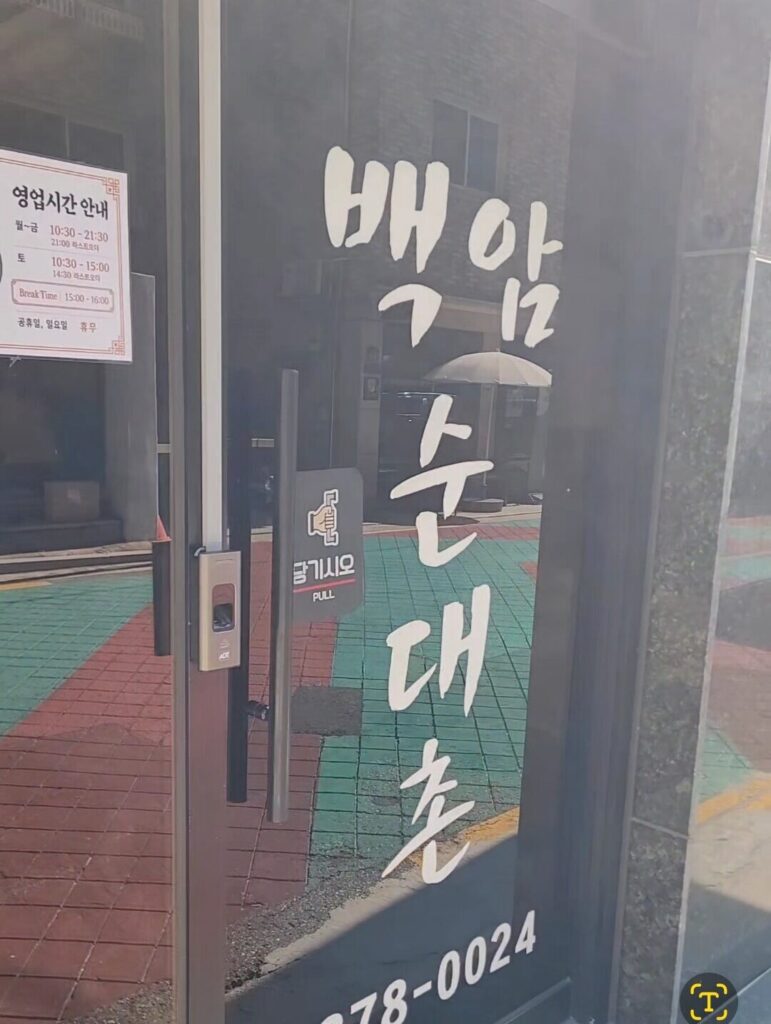
It’s closed on Sundays and public holidays. On Saturdays it closes at 3pm. If you want it on a weekend, Saturday lunch is your only chance.
Weekdays have a break from 3pm to 4pm, so a late lunch doesn’t work either. Turn up at 2:30 and you’re cutting it close.
Sangam is an office district, and the hours follow the office week. Plenty of people search for a lunch spot here, show up on a Sunday and find the door shut. Don’t be one of them.
What “Baekam” means

Baekam is a place: Baekam-myeon, a rural township in Yongin, south of Seoul.
In the Joseon era it sat on the road travellers took north to the capital, and it was home to one of the biggest cattle markets in the country. Its traditional five-day market (a market held every five days) has been running for centuries. The story locals tell is that sundae soup was what fed the traders who came to market, and their word of mouth did the rest.
Today Baekam sundae is usually named as one of Korea’s three great sundae styles, alongside Byeongcheon sundae and Abai sundae.
What sets it apart is the filling. The sundae at most snack stalls is mostly dangmyeon (sweet potato glass noodles, DAHNG-myun). Baekam-style sundae is pork, offal and vegetables, chopped coarsely rather than ground fine, so it has real texture. Cut one open here and the inside is dark, and you can see the pieces.
The menu
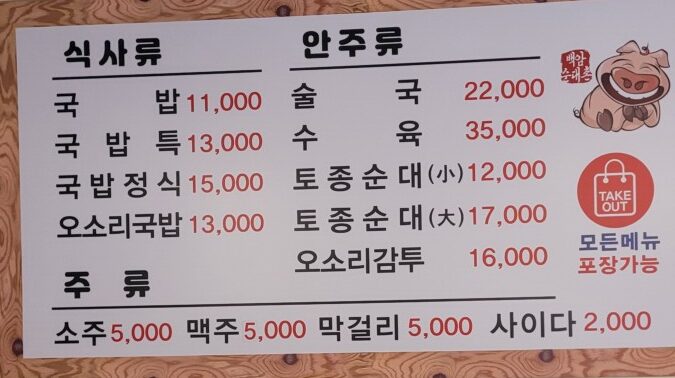
Copied straight from the menu board.
Meals
| Menu | Price | USD |
|---|---|---|
| Gukbap (sundae soup with rice) | ₩11,000 | ~$8.20 |
| Gukbap, special (특, teuk) | ₩13,000 | ~$9.70 |
| Osori gukbap (pig stomach soup) | ₩13,000 | ~$9.70 |
| Gukbap set (정식, JUNG-shik) | ₩15,000 | ~$11.20 |
To share
| Menu | Price | USD |
|---|---|---|
| Native-pig sundae, small | ₩12,000 | ~$9.00 |
| Native-pig sundae, large | ₩17,000 | ~$12.70 |
| Osori gamtu (sliced pig stomach) | ₩16,000 | ~$11.90 |
| Sulguk (a big pot of the soup, for drinking with) | ₩22,000 | ~$16.40 |
| Suyuk (boiled pork slices) | ₩35,000 | ~$26.10 |
Soju, beer and makgeolli (milky rice wine, MAHK-guh-lee) are ₩5,000 each (about $3.70). Cider (Korean-style lemon-lime soda) is ₩2,000.
The basic gukbap at ₩11,000 is a normal price for Seoul right now. Add ₩2,000 for the special, and another ₩2,000 for the set. The special and the osori gukbap carry more offal.
Everything on the menu can be taken away, and the menu board says so.
How the gukbap arrives
It comes to the table still boiling, in a ttukbaegi (a heavy earthenware bowl, TTOOK-beh-gee).
On top: a big heap of green onion, and a spoonful of seasoning paste in the middle. Underneath, it’s full. Head meat, sundae and offal, and noticeably more meat and sundae than at most sundae gukbap places I’ve been to. Every spoonful catches something.
The broth is on the light, clean side, not the heavy, boiled-down kind. It doesn’t have the weight pork broth sometimes has, which is why I kept going until the bowl was empty.
I tipped my rice in. There’s enough broth that it doesn’t turn stodgy.
Perilla powder and chili, by the tub

This is the part I remember most.
There are two containers on every table, each with a spoon in it. You don’t have to ask.
| Container | What’s in it |
|---|---|
| One | Perilla powder, filled to the top |
| The other | Chopped cheongyang chili, seeds and all |
Perilla (들깨, deul-kkae, said DULL-kkeh) is not sesame, though it looks similar. It’s a seed from a plant in the mint family, and Koreans grind it into a nutty, slightly earthy powder that goes into soups and stews.
The powder here is different from what I usually see. Most restaurants use a pale powder made from hulled seeds. This one is a deep brown. It looked like whole-seed perilla, ground with the hulls on, which has a stronger, toastier smell.
Stir it in and the soup changes. The light broth thickens and turns nutty. Add a lot and you’re close to deulkkae-tang (perilla soup). This powder is strong, so even one spoon makes a difference. Start with one, taste, then decide.
Cheongyang (CHUNG-yahng) is Korea’s go-to hot green chili. The seeds are left in here, so one spoonful is properly hot. Go easy.
Everyone eats sundae gukbap differently. Some people pile in perilla, some season only with salted shrimp, some stir in all the chili paste. This place hands that decision to you.
The side dishes

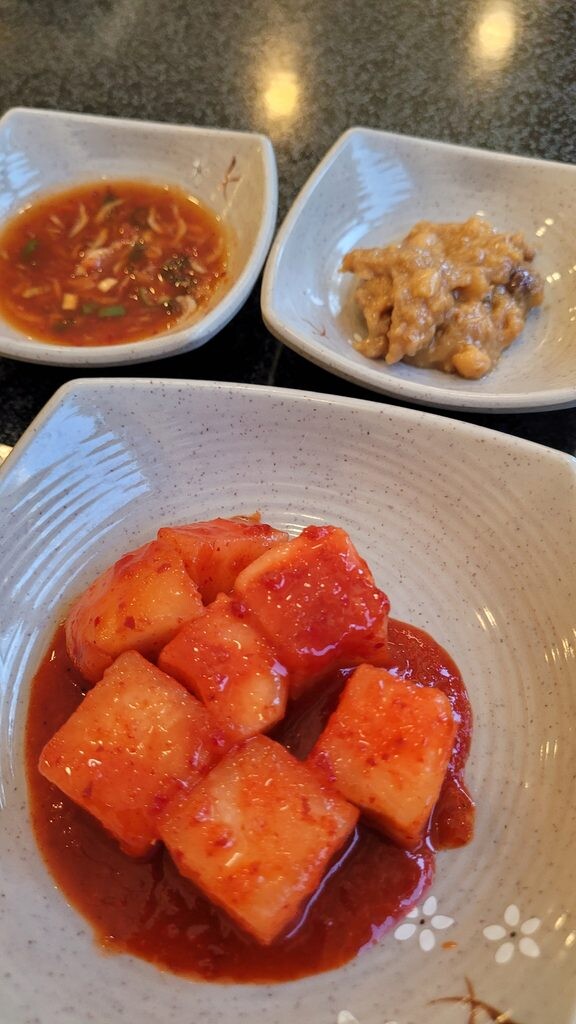
- Kkakdugi (cubed radish kimchi, KKAHK-doo-gee), red and juicy
- Buchu muchim (garlic chives in chili dressing, BOO-choo MOO-chim), a generous pile
- Raw onion and whole green chilies
- Saeujeot (salted tiny shrimp, seh-oo-JUHT), the classic way to salt this soup
- Dadaegi (spicy seasoning paste, dah-DEH-gee), in its own small dish
The salted shrimp and the chili paste come on the side, not already in the soup, so you set the salt and the heat yourself. It’s the same idea as the perilla tub.
Try putting some of the chive salad straight into the soup. It stays crunchy.
What is osori gamtu?


It’s on the menu twice: osori gamtu for ₩16,000, and osori gukbap for ₩13,000.
Osori gamtu (OH-soh-ree GAHM-too) is pig’s stomach. It’s chewy and rich.
The name is the fun part. Osori means badger, and gamtu was the hat a government official wore. In the Korean dictionary, the first meaning of osori gamtu is a hat made of badger fur. The second is this cut of pork.
The story goes that whenever a village butchered a pig, this part would quietly disappear, the way a badger vanishes into its burrow. And people fought over it the way officials fought over a post. Whether or not that’s true, it tells you how much people wanted it.
If you like chewy cuts, order the osori gukbap.
📍 How to get there
백암순대촌 (Baekam Sundaechon) 서울 마포구 성암로13길 7 1층
Screenshot that Korean address. Showing it to a taxi driver beats pronouncing it, and it works with no data connection.
| Weekdays | 10:30 – 21:30 (last order 21:00) |
| Break | 15:00 – 16:00, weekdays |
| Saturday | 10:30 – 15:00 (last order 14:30) |
| Closed | Sundays and public holidays |
| Phone | +82-2-6378-0024 |
| Station | Digital Media City (DMC): Line 6, Gyeongui–Jungang, AREX |
| Parking | No lot of its own. Use the public parking lot at DMC station and walk |
| Takeaway | Everything on the menu |
DMC is on the AREX line, which runs straight from Incheon Airport.
The chicken stew restaurant we wrote up is on the same street, and the ssambap place on a second floor is a few minutes’ walk away.
What I’d tell you before you go
Go on a weekday. Sundays and holidays it’s shut, and Saturdays end at 3pm. This is the one thing that will catch you out.
One spoon of perilla first. It’s stronger than the powder you may have had elsewhere.
Respect the chili. The seeds are in.
It’s fine alone. A bowl of gukbap is one of the easiest meals in Korea to eat by yourself: one bowl, one person.
The downsides are all about timing. Short weekend hours, a weekday break, and no parking of its own. The food itself gave me nothing to complain about.
If you’re looking for a bowl of sundae gukbap in Sangam, Baekam Sundaechon is a good one. Lots of meat and sausage, a clean broth, and the seasoning left up to you. Just go on a weekday.
Prices and hours as of October 2026.