We sat down at a Korean chicken stew place near Digital Media City station
Tteokbokki, in a rice cooker. Acorn jelly dressed in perilla oil. A bowl of seasoned cockles. Nobody asked for any of it and nobody was going to charge for any of it.
All three get refilled, for as long as you’re sitting there, at no charge.
And the third one is on this restaurant’s own menu, as a dish you can order, starting at ₩15,000.
That’s the part worth explaining, and it isn’t generosity. But before that, there’s something stranger about this place, and it’s written on the outside of the building.
The sign and the menu disagree

The sign over the door says the restaurant specialises in dakbokkeumtang (닭볶음탕) — say it dahk-BOK-kum-tahng.
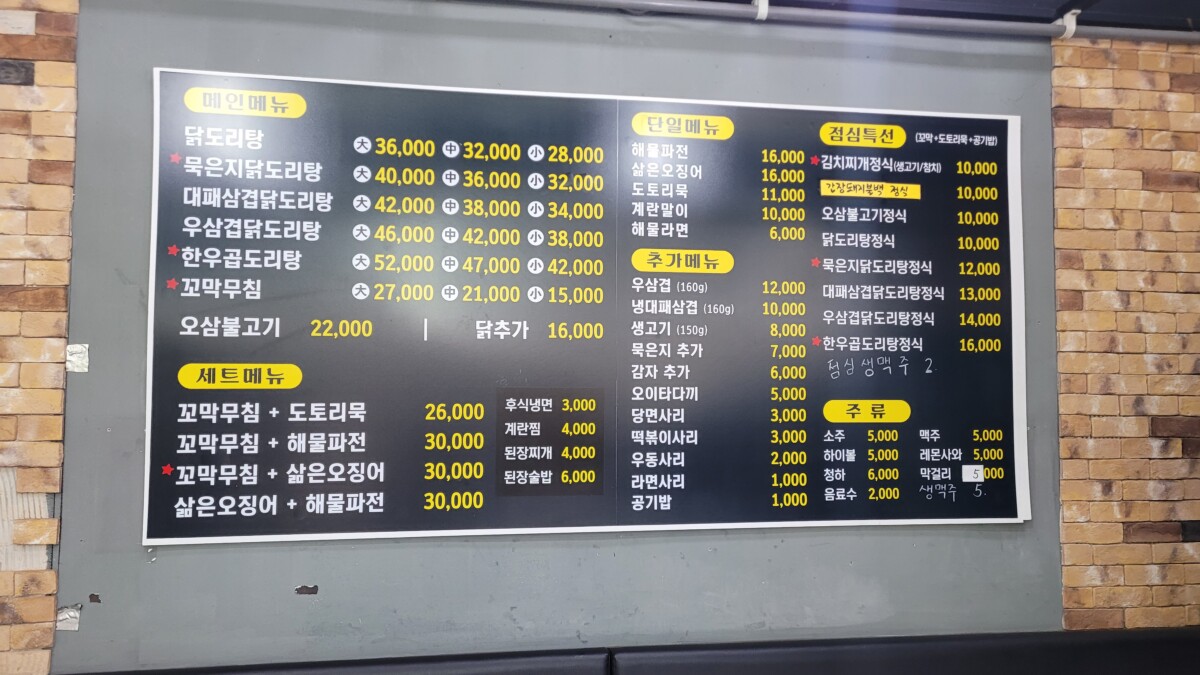
The menu inside lists dakdoritang (닭도리탕) — dahk-DOH-ree-tahng.
Same dish — Korean chicken stew. Chicken, potatoes, carrots and onion simmered in a red,, garlicky, gochugaru-heavy sauce until the chicken falls apart. One of the most ordinary things a Korean family eats.

So why two names?
Because Korea has a government body that renames food, and this restaurant has quietly declined to pick a side.
What happened
In 1992 the Ministry of Culture listed 닭도리탕 among terms thought to be Japanese-derived and recommended 닭볶음탕 instead. In 1997 the National Institute of the Korean Language published an etymological dictionary explaining 도리 as the Japanese word とり (tori, bird). Under that reading, 닭도리탕 would be “chicken-bird-stew” — a Korean word, a Japanese word, and a Chinese character, with the first two meaning the same thing.
Korea spent most of the twentieth century under and then after Japanese occupation, and removing Japanese residue from the language has been official policy for decades. So the dish was renamed to 닭볶음탕, literally “chicken stir-fry stew.”
Then people pushed back, and they had documents.
Food historians pointed to 『조선무쌍신식요리제법』 (1924) and 『해동죽지』 (1925), both of which record the dish in Chinese characters as 桃李湯 — read doritang. Not the Japanese tori. They also noted that 도리치다 is an old Korean verb meaning to cut something into pieces, which is exactly what you do to a chicken before it goes in the pot, and that there are other Korean dishes built on the same root.
The argument broke into public view in 2012 when the novelist Lee Oe-soo said on Twitter that 도리 was native Korean, and it has never really been settled since.
Here is the National Institute of the Korean Language’s own position, posted from its official account:
국립국어원에서는 ‘닭도리탕’의 ‘도리’가 일본어 ‘とり’에서 온 것이라 보고, 이를 ‘닭볶음탕’으로 다듬었습니다. ‘도리’의 어원에 대해 다른 견해가 있는 것은 알고 있습니다만, 분명한 근거를 찾기 어렵습니다.
We regard the ‘dori’ in ‘dakdoritang’ as coming from the Japanese ‘tori’, and refined it to ‘dakbokkeumtang’. We are aware there are other views on the etymology of ‘dori’, but clear evidence is hard to find.
That is a national language authority saying, in public, that its own ruling rests on evidence it cannot firmly establish. In 2016 the Institute said it would carry out further research. It is still the standard form.
What this means if you’re ordering
Say dakdoritang. That is what nearly everyone says out loud, in restaurants, at home, every day. 닭볶음탕 is what gets printed on signs, menus produced by franchise head offices, broadcast subtitles and school textbooks.
This restaurant has it both ways — the official word facing the street, the spoken word on the table. You’ll see that split all over Korea once you know to look for it.
There is no equivalent in English. No agency decides what Americans call a sandwich.
The rice cooker of tteokbokki
Now back to the free food, which is the reason to come here.

Tteokbokki — ttuhk-BOK-ki, the chewy rice cakes in sweet chili sauce that Korea eats as street food — sits in an electric rice cooker, kept hot. Staff refill your plate from it, and they keep refilling it.
With one honest limit: when the cooker is empty, it’s empty. Nobody starts a new batch to order. Arrive late in a service and there may not be much left in it.
I like that the limit is stated rather than buried. “All you can eat” is a promise a restaurant can come to regret. “Until it runs out” is one it can keep.
The two dishes nobody mentions
Alongside the tteokbokki, two more arrive unasked.
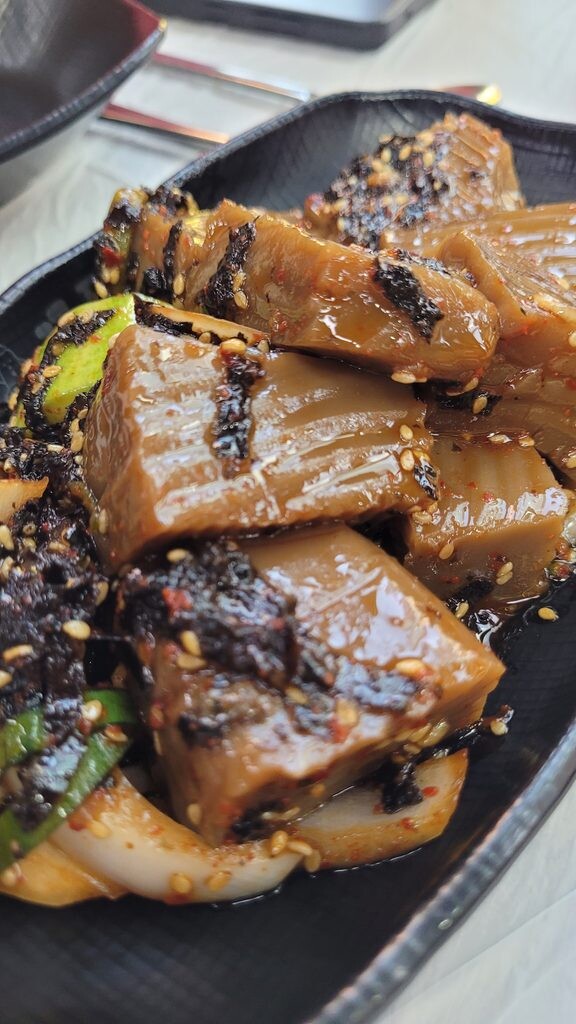

Dotorimuk — 도토리묵, doh-toh-ree-MOOK — is acorn jelly. Acorns, leached and ground and set into a soft grey-brown block with the texture of very firm panna cotta and almost no flavour of its own. Here it comes shredded and dressed with perilla oil, soy and sesame seeds. It’s the kind of thing Koreans grew up eating and foreigners rarely order, because nothing about the description sells it.

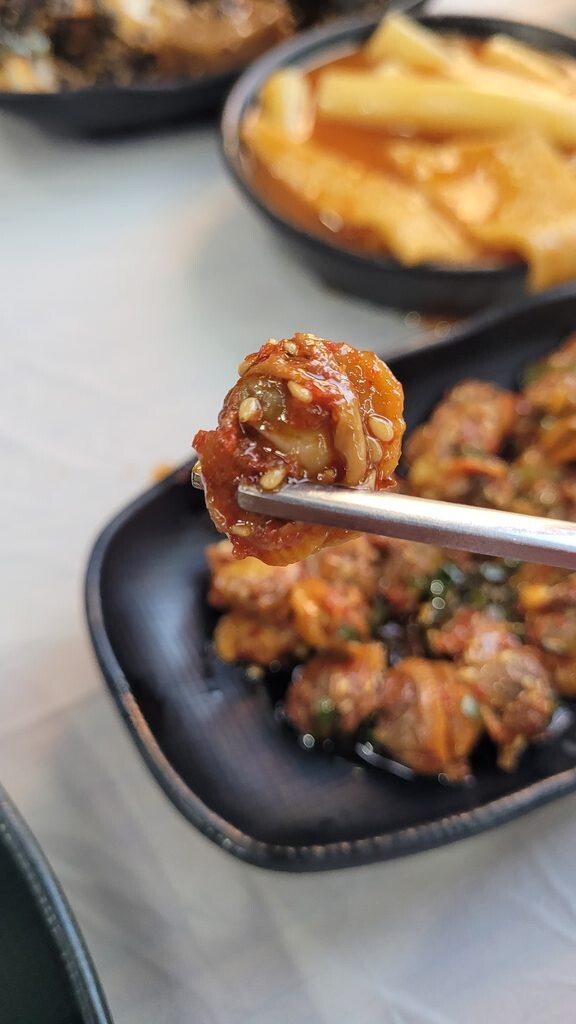
Kkomak muchim — 꼬막무침, KKOH-mahk — is blood cockles, shucked and tossed in a spicy, garlicky dressing. Small, dark, mineral, slightly sweet. It’s a southwestern Korean specialty and this restaurant’s second named specialty after the chicken.
And it’s on the menu, as a dish you can order, from ₩15,000 to ₩27,000.
Both of these refill as well. Finish the cockles and more cockles arrive. Finish the acorn jelly and more acorn jelly arrives. A dish this restaurant sells for ₩15,000 — about $11 — is put in front of you before you order, and then put in front of you again.
The free serving is a side-dish portion rather than the ₩15,000 plate. But it’s the same preparation, and once it refills, the difference is mostly theoretical.
If that reads like a hole in the business model, it isn’t. Banchan in a Korean restaurant is structurally free — not a courtesy, not a loss leader, but part of what the price of a main course already covers, refills included. What makes something banchan is where it sits on the table, not what it is. Cockles sold as a plate are a dish. The same cockles arriving beside a stew are banchan.
This restaurant does both at once, on one menu. That makes the logic unusually easy to see — and it also shows you what the rule actually costs a restaurant that follows it properly.
What we ordered
Mugeunji dakdoritang — 묵은지닭도리탕.
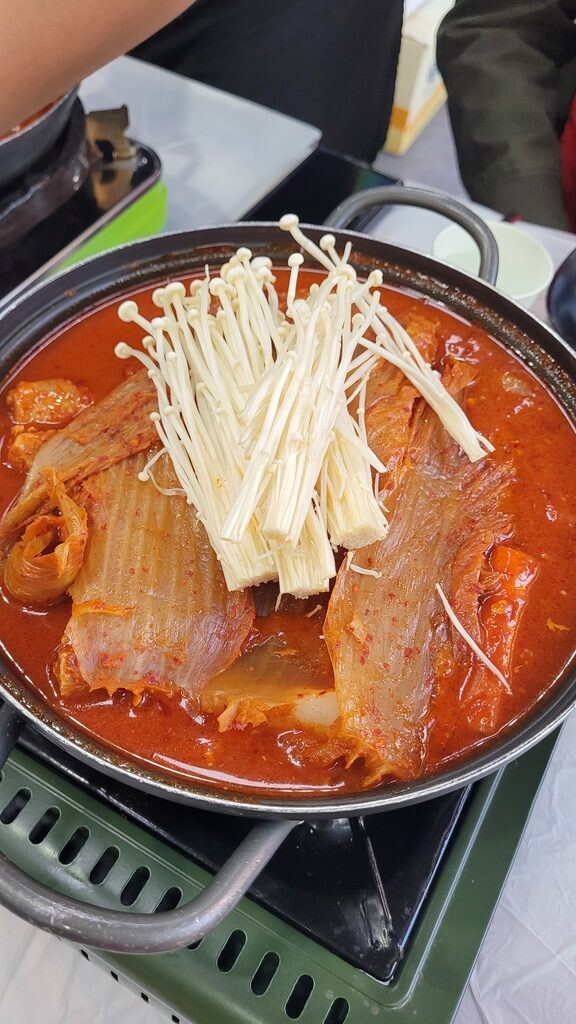
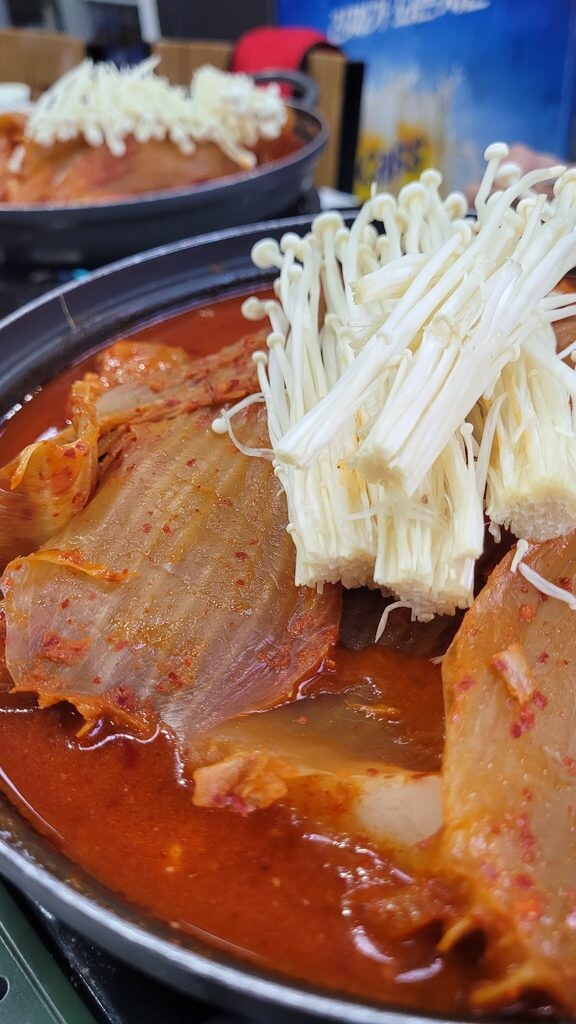
Mugeunji — moo-GUN-ji — is kimchi that’s been aged for months until it’s gone properly sour and soft. Korean households keep it specifically for cooking; it’s too sharp to eat plain by then, and that sharpness is exactly what you want in something braised.
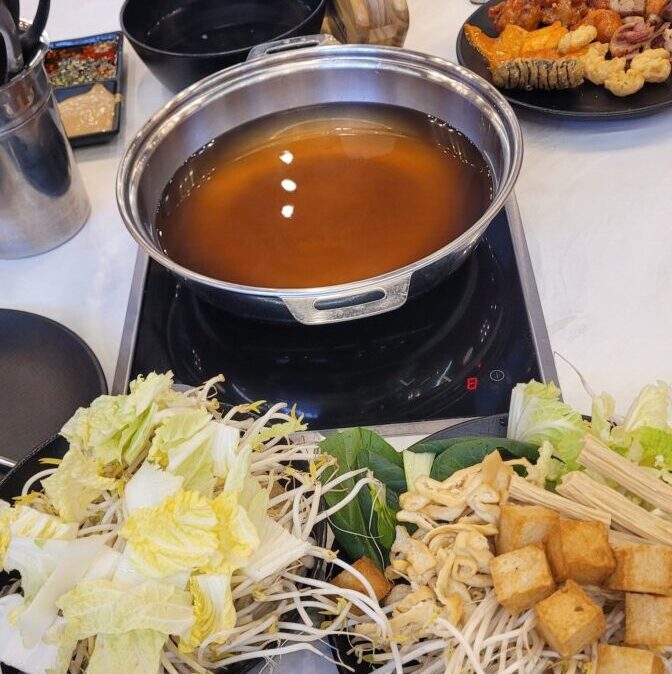
It came to the table with a mound of enoki mushrooms piled on top and kept cooking in front of us. The aged kimchi gives it a cleaner, sourer heat than plain dakdoritang, with more depth underneath. As the enoki cooked down it thickened the broth.

If you’ve read our kimchi stew recipe, this is the same principle running under a different dish: sour kimchi does something to pork and chicken that fresh kimchi can’t.
The seasoned bean sprouts and the kimchi that came with it were both restrained — not the aggressive version you sometimes get.
The menu
| Small | Medium | Large | |
|---|---|---|---|
| Dakdoritang | ₩28,000 | ₩32,000 | ₩36,000 |
| With aged kimchi | ₩32,000 | ₩36,000 | ₩40,000 |
| With thin-sliced pork belly | ₩34,000 | ₩38,000 | ₩42,000 |
| With thin-sliced beef brisket | ₩38,000 | ₩42,000 | ₩46,000 |
| With Korean beef intestine | ₩42,000 | ₩47,000 | ₩52,000 |
| Seasoned cockles | ₩15,000 | ₩21,000 | ₩27,000 |
Small is about $21 and feeds two. The ladder is worth reading as a ladder: the base dish is chicken, and each step up adds a second protein to the same pot. Aged kimchi, pork belly, beef brisket, then beef intestine at the top — ₩52,000, about $39.
That’s a very Korean way to build a menu. You’re not choosing between dishes, you’re choosing how much to put in one pot.
The ₩12,000 lunch set
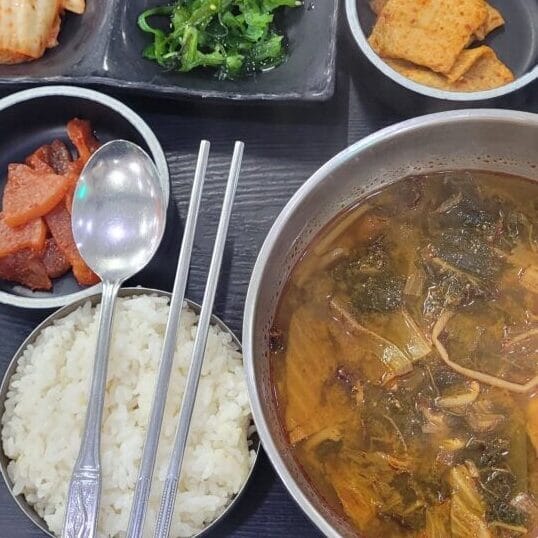
At lunch there’s a separate run of sets from ₩10,000 to ₩16,000 — roughly $7.50 to $12 — each including cockles, acorn jelly and rice. We had the aged-kimchi set at ₩12,000, about $9.
This is the third restaurant we’ve written up in this neighbourhood, and all three run a cheaper weekday lunch. That’s not a coincidence: the weekday lunch special is a national business structure in Korea, not a promotion. Office districts like Sangam are where it’s most visible, because the same room has to serve expense-account dinners and a nine-dollar lunch crowd.
If you’re coming here for the first time and you don’t want to commit ₩32,000, come at lunch.
📍 How to get there
꼬닭 서울 마포구 성암로13길 30-1 1층
NAVER GOOGLE
Screenshot that Korean address. Showing it to a taxi driver beats pronouncing it, and it works with no data connection.
| Hours | 11:10 – 22:00 |
| Station | Digital Media City (DMC) — Line 6, Gyeongui–Jungang, AREX |
| Parking | Valet and self-parking both available |
| Payment | Takes Seoul Love Gift Certificates (local vouchers) |
DMC is on the AREX line, which runs directly from Incheon Airport. If you’re arriving in Korea and heading to western Seoul, you can be here without changing trains.
The building also carries a 모범음식점 plaque — “exemplary restaurant,” a designation local governments award on hygiene and service inspections. It isn’t a food award and it says nothing about taste, but it does mean somebody official has been through the kitchen.
There’s another restaurant we’ve written about a few minutes from here, on a second floor you’d never find by walking past.
What I’d tell you before you go

The free food is the reason to come, and that’s not a criticism. The stew was good — sour, deep, properly spicy. But the thing we talked about afterwards was the table before the stew arrived.
Only the tteokbokki has a ceiling. The cockles and the acorn jelly keep coming. The tteokbokki keeps coming until the cooker is empty, so arriving late in a service means less of it.
We didn’t test eating alone. There are lunch sets priced per person, which suggests solo diners are expected, but we went as a group and we’re not going to tell you what we didn’t check. If you’re travelling alone in Korea, a place serving a shared pot is always worth a phone call first.
Dakdoritang has bones in it. Not boneless chunks — chicken cut through the bone, the way Korean home cooking does it. That’s where the flavour in the broth comes from, and it’s also something to know before you order it for someone who won’t want to deal with it.