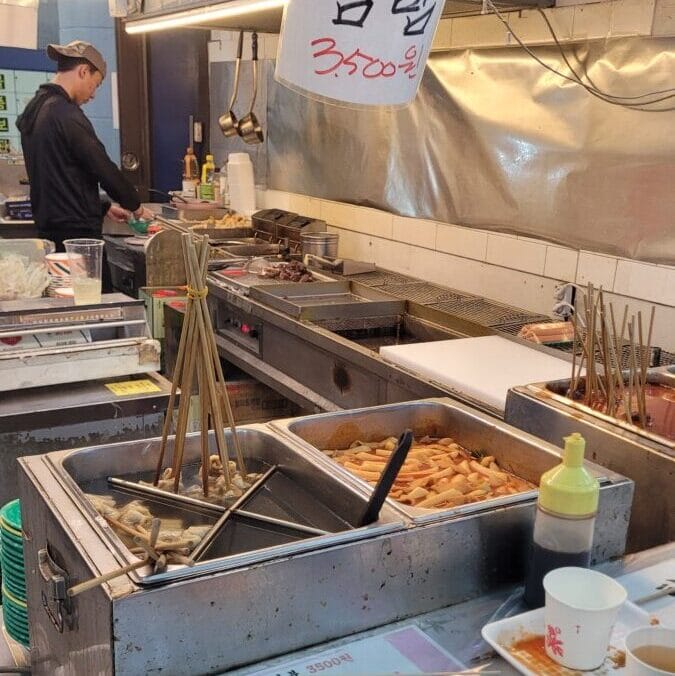

Most Americans meet Korean pork belly one way: sizzling on a grill built into the table, smoke everywhere, tongs and scissors.
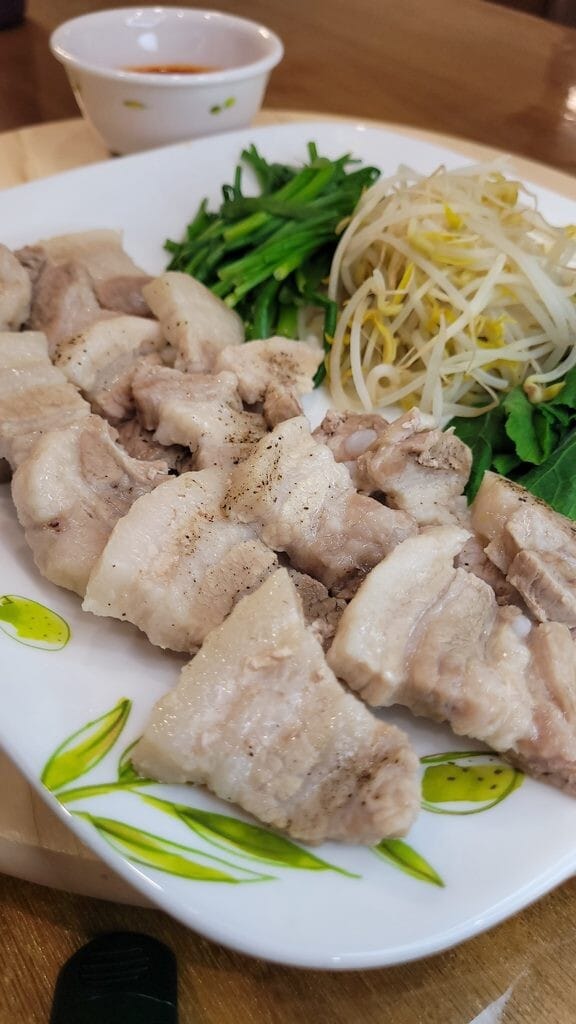
Korean steamed pork belly is the other way, and it’s the one you can actually do at home on a Tuesday.
No grill. No smoke. No standing over anything. You stack cabbage and pork in a steamer, pour half a bottle of soju over it, close the lid, and walk away for twenty minutes.
The result is suyuk (수육) — pork that’s tender, clean-tasting, and noticeably less greasy than the grilled version, because a lot of the fat renders out and drips away instead of pooling on a hot plate.
Suyuk, bossam, samgyeopsal: what’s the difference?
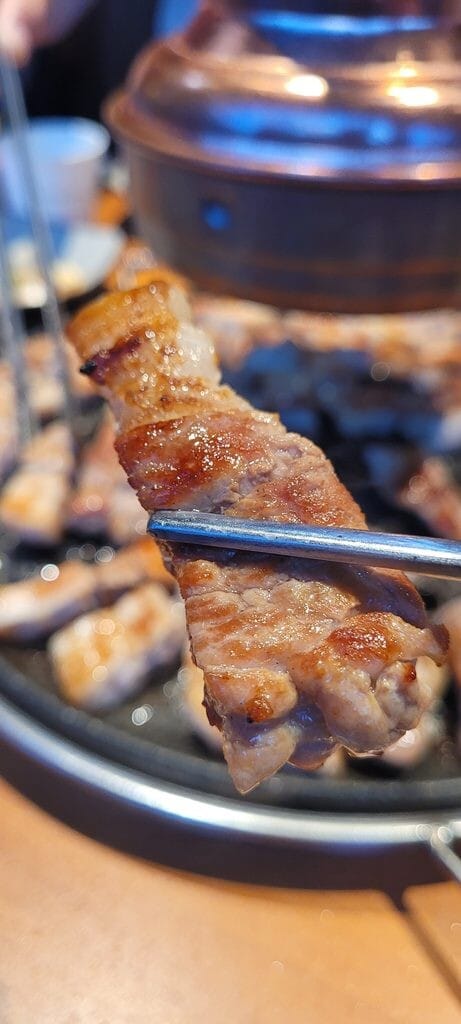

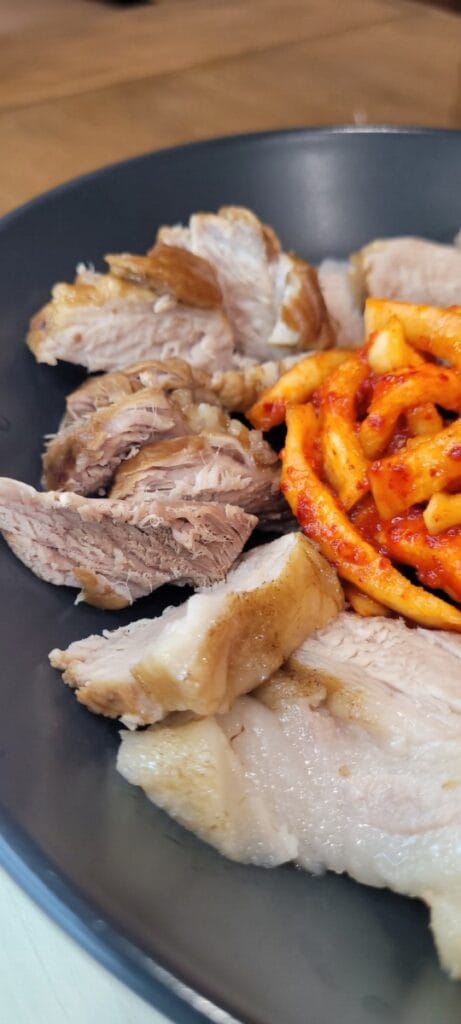
These three show up on the same menus and confuse people constantly.
Samgyeopsal is the grill. Raw pork belly, cooked at your table, eaten with the fat still sizzling. It’s the one most Americans have had.
Suyuk is the meat itself — pork belly cooked in water or steam, then sliced. No grill, no smoke, no char. The texture is completely different: soft rather than crisp, clean rather than rich.
Bossam is a meal built around suyuk. Same meat, but served as a set with kimchi, salted shrimp, raw oysters in season, and leaves for wrapping. If you order bossam at a restaurant, suyuk arrives — plus everything around it.
So this recipe is suyuk. Add kimchi and oysters and you’ve made bossam at home.
Why steam instead of boil?
Traditional suyuk is boiled. A big pot, water to cover, and a handful of things to kill the smell — doenjang, scallion, ginger, sometimes coffee grounds or bay leaf. It works, and it’s what most Korean households do.
Steaming does the same job with two differences.
Less flavor leaves the meat. Boiled pork gives a lot of itself to the water. That’s fine if you’re keeping the broth, but most people pour it out. Steam never sits on the meat long enough to pull it away.
No pot to manage. No skimming, no watching the water level, no lifting a heavy pot of hot liquid. You stack, pour, close the lid, and leave.
The trade-off is that steaming needs a steamer. If you don’t have one, a metal colander over a pot with a tight lid does the job.
Why there’s soju in this recipe
This is the part that stops people.

Poured over the meat — don’t be careful about it

Pork has a particular smell when it cooks — Koreans call it jabnae (잡내), roughly “off-smell.” Korean cooking has a whole toolkit for dealing with it: ginger, coffee grounds, doenjang, perilla seed, and alcohol.
Soju is the easy one. Soju is the easy one. You pour it over the raw meat before any heat goes on; as the steamer comes up to temperature the alcohol evaporates and carries the smell out with it, and what’s left is cleaner pork. It doesn’t make the dish taste like soju.
No soju? Use one of these:
| Instead of ½ bottle soju (180ml / ¾ cup) | Notes |
|---|---|
| Dry sake, same amount | Closest match |
| Vodka, 120ml, plus 60ml water | Neutral, works fine |
| Dry white wine, same amount | Slight flavor, still good |
| Water + 2 slices fresh ginger | Non-alcoholic. Less effective but fine |
Shopping notes for the US
Pork belly is the easy part now. Most large supermarkets carry it, and any Asian market will. Ask for it skinless and sliced, about 1cm thick — roughly the thickness of a pencil. If you can only get a slab, slice it yourself; it’s easier when very cold.
Napa cabbage is in most supermarkets. Korean recipes call for ssambaechu, the small tender inner head — the pale inner leaves of a regular napa do the same job.
Ssamjang and gochujang come in tubs at any Korean or Asian market, and increasingly at Whole Foods and larger chains. Both keep for months in the fridge. If you buy one Korean condiment, gochujang is the one that earns its shelf space.
Maesil-cheong (green plum syrup) is the one you may not find. Substitutes, in order of preference:
- Honey, 1½ Tbsp + rice vinegar, ½ tsp — closest
- Apricot jam, 2 Tbsp, thinned with ½ tsp water
- Brown sugar, 1 Tbsp + 1 tsp rice vinegar


Squash leaves are a Korean-market item and seasonal. Leave them out — the dish works without. Or swap in collard greens, which behave similarly when steamed.

Korean Steamed Pork Belly (Suyuk)
Equipment
- 1 Steamer bamboo or metal basket with a lid
Ingredients
For the pork
- 1.5 lb pork belly skinless, sliced 3/8 inch thick
- 12 leaves napa cabbage
- 3/4 cup soju about half a bottle
- 1/2 tsp black pepper
To add at the end
- 3.5 oz garlic chives
- 7 oz mung bean sprouts
- 6 leaves squash leaves optional
For the dipping sauce
- 2 tbsp ssamjang
- 1 tbsp gochujang
- 2 tbsp maesil-cheong green plum syrup — substitutes in the post
- 2 tbsp onion minced
- 1 tbsp scallion minced
- 1 tsp water
Instructions
- Line the bottom of a steamer basket with napa cabbage leaves, generously — a full layer, not a scattering. This keeps the pork off the metal and catches the drips.
- Lay the pork belly on top in a single layer, not overlapping. Grind black pepper over it.
- Add another layer of cabbage, then the rest of the pork on top.
- Pour the soju evenly over the meat, before any heat goes on. Don't be careful about it; cover everything.
- Lid on, heat on. Once the water underneath is boiling and the basket is steaming, set a timer for 20 minutes.
- While it steams, make the sauce: stir the ssamjang, gochujang, plum syrup, minced onion and scallion together, adding water a few drops at a time until it’s dippable rather than stiff.
- Open the lid and add the garlic chives, bean sprouts and squash leaves on top. Steam 5 minutes more.
- The pork should be opaque all the way through with no pink. If you use a thermometer, the USDA safe minimum for whole pork cuts is 145°F / 63°C — this will be well past it. Serve straight from the steamer with the sauce, rice and kimchi.
Notes
How to eat it
Like ssam — wrapped.
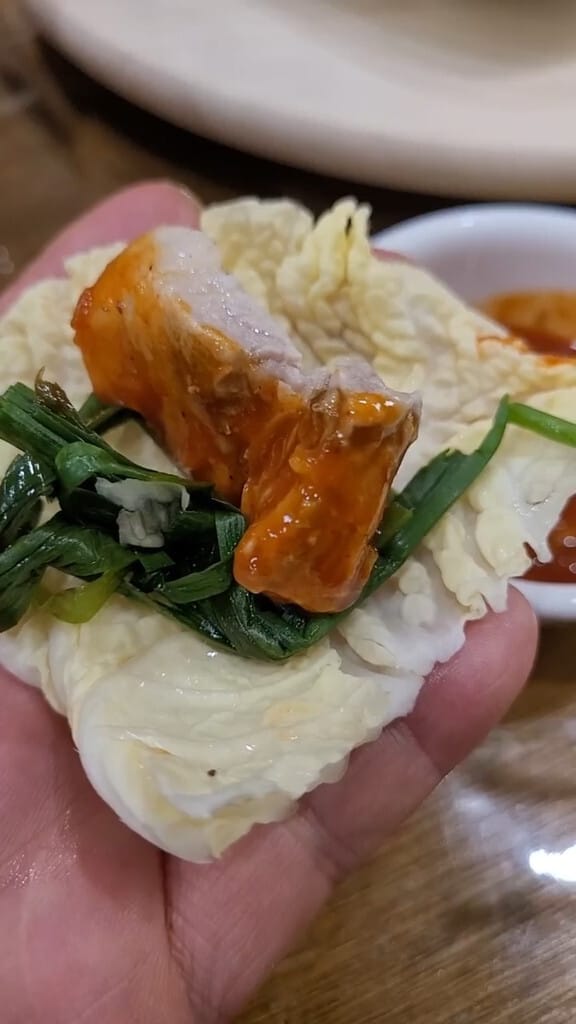
Fold it closed and eat it in one bite

Take a cabbage leaf, add a piece of pork, a dab of sauce, some of the chives or sprouts, fold it closed and eat the whole thing in one bite. A Korean wrap is built as a single mouthful; biting it in half is how you end up with it in your lap.