Walk into a Korean apartment and open the kitchen. There’s a good chance you’ll find two refrigerators, or one refrigerator with four doors where one of those doors is not for food in general.
It’s for kimchi.
Store-bought kimchi is what most of those fridges now hold. Including ours.
An entire appliance for one food
The kimchi naengjanggo — kimchi refrigerator — is a separate category of appliance in Korea, sold in stores next to washing machines and air conditioners. About 85% of Korean households own one, according to Gallup Korea’s 2025 survey of household appliances.
It exists because kimchi is alive. It keeps fermenting, and the rate depends entirely on temperature. A regular refrigerator cycles between warm and cold as its compressor kicks on and off, which is fine for milk and terrible for kimchi — it sours fast and unevenly. A kimchi fridge holds a steady low temperature, no cycling, and keeps kimchi at the stage you want it for months.
The drawer in our kitchen is labeled Metal Cooling — the walls of the compartment are metal rather than plastic, so cold transfers directly into the container instead of being blown around it as air. That’s the whole engineering argument in two words, printed on the drawer.
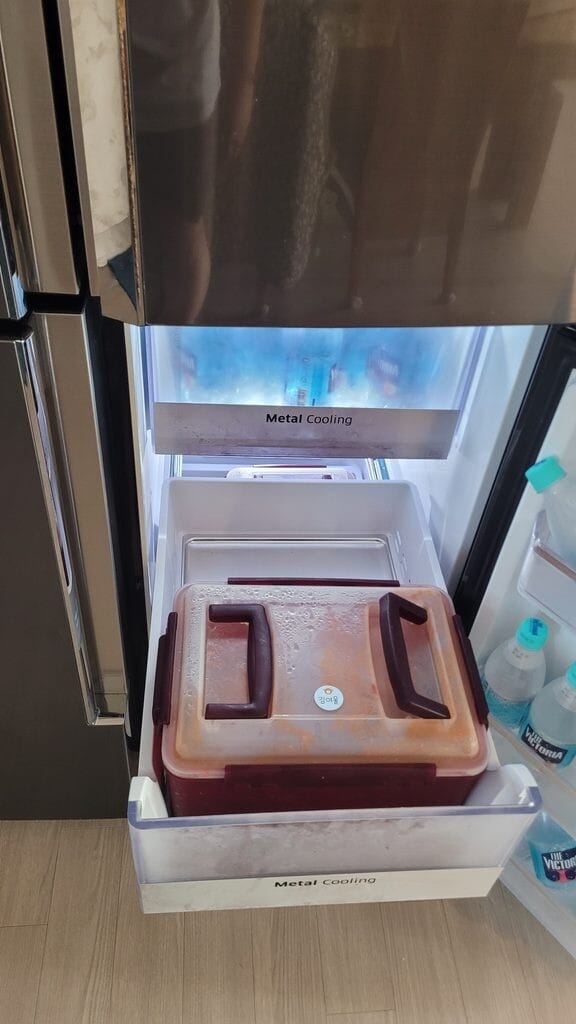
Newer four-door refrigerators have absorbed the function. One compartment runs on kimchi settings while the rest of the unit behaves like a normal fridge. That’s what most new apartments get now.
It’s worth sitting with that for a second. Korean homes dedicate an appliance — or a quarter of one — to a single side dish.
And almost nobody makes it
Here’s the part that doesn’t match the pictures.
If you’ve read about Korean food in English, you’ve seen kimjang — the late-autumn ritual where families salt a hundred heads of cabbage at once, everyone in rubber gloves, grandmothers directing traffic. UNESCO added it to the Representative List of Intangible Cultural Heritage in 2013.
It still happens. It’s just no longer what most people do.
In a 2022 survey by the Korea Rural Economic Institute, 25.7% of households said they simply buy their kimchi rather than making it. In 2017 that number was 13%. It doubled in five years.
We’re in that quarter. We buy ours.
Why it changed
Apartments don’t have the space. Kimjang needs somewhere to salt and rinse a hundred cabbages, and a Korean apartment kitchen is not that place. The practice was built for houses with yards and cold storage.
Households got smaller. A single person or a couple cannot eat a hundred heads of cabbage before it turns. Making a small batch is more work per jar than buying it.
The labor is real. Kimjang is two days of heavy, cold, wet work. Salting, rinsing, mixing, packing. It was a group activity because one person couldn’t do it alone, and the group — extended family, neighbors — is the part that dissolved first.
And the fridge cut the other way. The kimchi refrigerator was invented to store a year’s supply. But it also made buying one container at a time perfectly practical, because whatever you buy stays good.
So buy it — store-bought kimchi is what Koreans do
If you’ve been putting off kimchi because making it felt like the only legitimate option — you can stop.
There is no authenticity problem with buying kimchi. The kimchi in a Korean restaurant is usually made by a supplier, not the owner. The kimchi in a Korean home is, one time in four, from a store. Buying it is the normal Korean experience of kimchi, not a shortcut around it.
The package will tell you in English
This is the practical thing nobody mentions, and it changes the whole shopping trip.
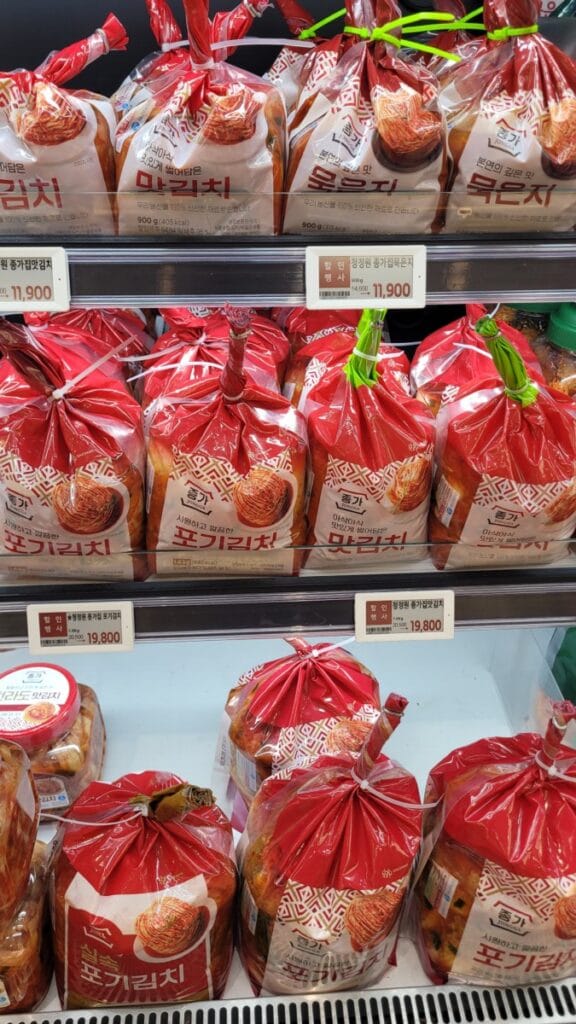
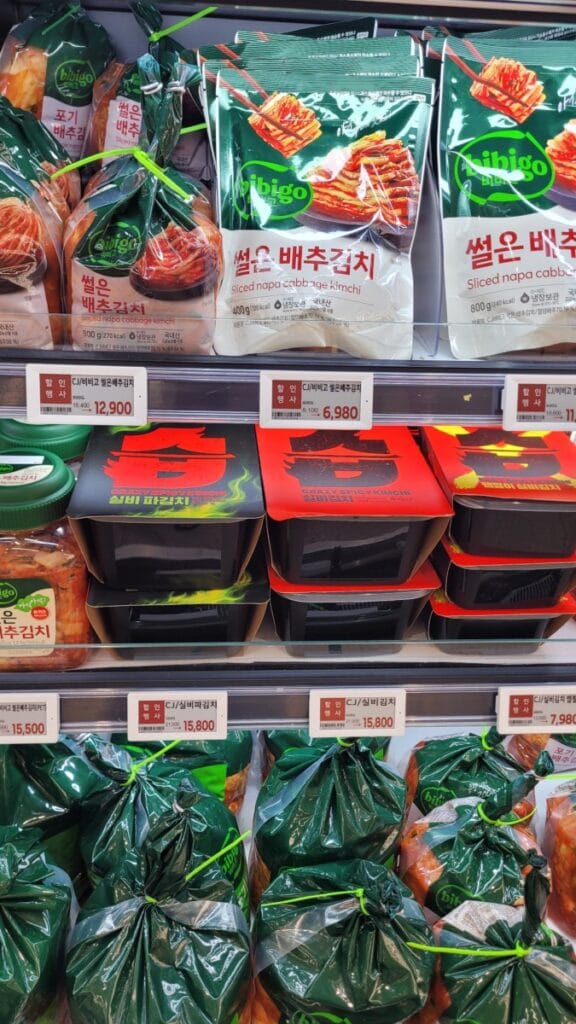
The two brands that fill most of the kimchi shelf in a Korean supermarket are Bibigo (비비고) and Jongga (종가). Bibigo prints the English name of the product directly on the front of the package, under the Korean. Not a sticker, not an export label — it’s on the domestic packaging, in the store in Seoul.
So the bag actually says Whole napa cabbage kimchi. Or Sliced napa cabbage kimchi. Or Aged kimchi. Or Young radish kimchi. You do not need to translate anything or ask anyone. Stand in front of the case and read.

If you’re in a Korean market outside Korea, the same packaging usually travels with the product.
What to look for
Here’s what’s on the shelf, and what each one is for.
The cabbage ones
Pogi-kimchi (포기김치) — whole napa cabbage kimchi. Quarters of cabbage with the leaves still attached. This is the default, the one in the photos you’ve seen. You cut it with scissors at the table.
Mat-kimchi (맛김치) — sliced napa cabbage kimchi. The same cabbage kimchi, pre-cut into bite-size pieces. Jongga prints the Korean name mat-kimchi on the bag; Bibigo skips the Korean name and just calls it sliced napa cabbage kimchi. Same thing. Easier, no scissors, slightly less impressive on a plate. This is the one to start with.
Mugeunji (묵은지) — aged kimchi. Months to years old, sour and deep and soft. Don’t buy this as your first kimchi. It is a cooking ingredient, not a side dish. It’s what goes into kimchi stew and braises.
Geotjeori (겉절이) is fresh, unfermented kimchi, closer to a salad. It’s made to eat within days and tastes nothing like the sour version. You’ll see it more in restaurants than on the shelf.
The radish ones
Chonggak-kimchi (총각김치) — ponytail radish kimchi. Small whole radishes with the greens left on, eaten one at a time. Crunchy in a way cabbage kimchi never is. Excellent with grilled meat.
Yeolmu-kimchi (열무김치) — young radish kimchi. Thin summer radish with the leaves, lighter and more watery. It’s the kimchi you mix into cold noodles or a bowl of rice with gochujang.
The ones that surprise people

Baek-kimchi (백김치) — white kimchi. No chili at all. Cabbage fermented in a clear, lightly salty, slightly sweet brine. If you have been told kimchi is a spicy food, this is the counterexample. It’s also what to serve someone who can’t handle heat, and it’s genuinely good — cold, clean, a little fizzy.
Gat-kimchi (갓김치) — mustard leaf kimchi. Made from whole mustard greens, with a sharp, almost horseradish bite that comes from the leaf itself rather than the chili. A specialty of Yeosu in the south. It is a strong flavor and people either love it immediately or don’t.
Silbi-kimchi (실비김치) — sold with CRAZY SPICY written across the bag in English, which is a fair warning. This is the extra-hot version, and the heat is the point of it. Skip it on your first trip.
What it costs
Real prices from a Korean supermarket this month, at roughly ₩1,366 to the dollar:
| Kimchi | Size | Price | USD |
|---|---|---|---|
| Whole cabbage (pogi) | 900 g | ₩11,500 | about $8.40 |
| Sliced (mat) | 900 g | ₩12,900 | about $9.40 |
| Sliced (mat) | 400 g | ₩6,980 | about $5.10 |
| Sliced (mat) | 200 g | ₩3,780 | about $2.80 |
| Sliced (mat) | 100 g | ₩2,250 | about $1.60 |
| Aged (mugeunji) | 400–500 g | ₩5,980 | about $4.40 |
| White (baek) | 400–500 g | ₩6,980 | about $5.10 |
| Mustard leaf (gat) | 400–500 g | ₩8,980 | about $6.60 |
| Ponytail radish (chonggak) | — | ₩8,280 | about $6.10 |
| Young radish (yeolmu) | — | ₩8,980 | about $6.60 |
| Large family pack | 1.6 kg | ₩19,800 | about $14.50 |
The small packs are the reason to relax about all of this. A 100-gram pack costs about a dollar sixty. You can buy four different kinds, eat them over a week, and find out what you actually like for the price of one sandwich.
Check the date on the package, and know that it isn’t an expiration date so much as a clock. Kimchi bought today will be mild. The same container in three weeks will be sour. Neither is wrong.
Kimchi doesn’t stay the same
This is the thing most English-language writing about kimchi leaves out, and it’s the whole point of the fridge.
Kimchi has stages. Fresh, it’s crunchy and sharp, good eaten straight. After a few weeks it turns properly sour, and that’s when it’s best with rich food — grilled pork, steamed pork belly, anything fatty. After a few months it becomes mugeunji, too strong to eat plain, and it goes in the pot.
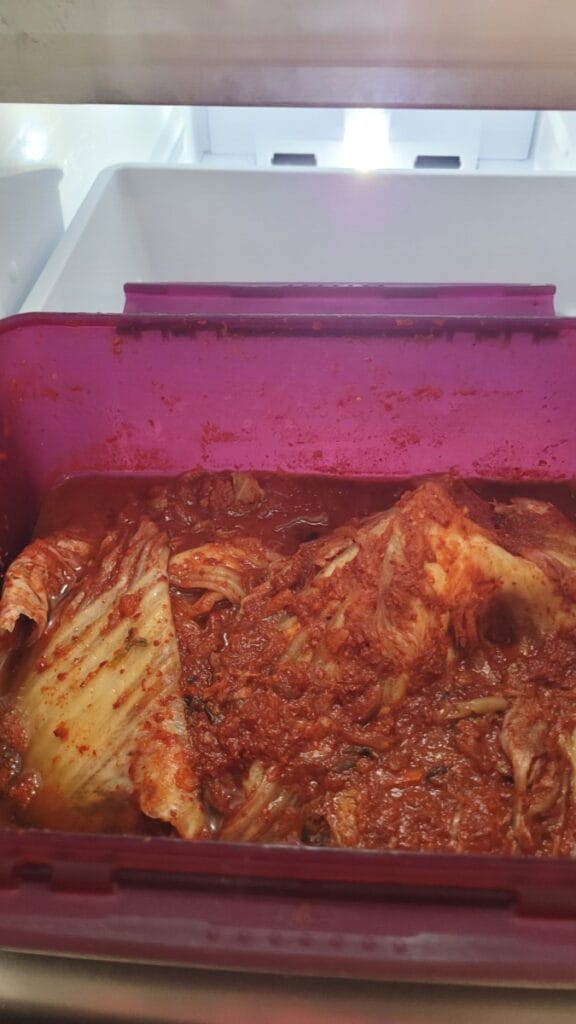
So a jar of kimchi isn’t one ingredient. It’s three ingredients arriving in sequence, and Koreans use each stage for something different. If the kimchi in your fridge has gone sour and you think you’ve ruined it — you haven’t. You’ve just reached the next stage, and there’s a dish waiting for it.