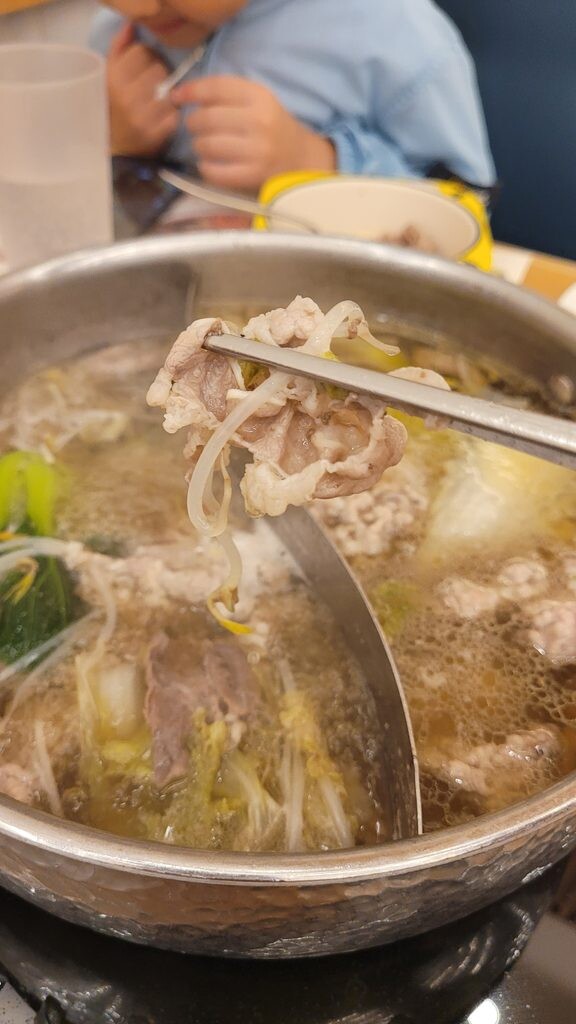
The first thing you do at a Korean shabu-shabu buffet is not pick your meat. It’s pick your broth — two of them, from a list of seven, poured into a divided pot that sits in the middle of your table for the rest of the meal.
The second thing you should do is read the sign by the door.
It’s a standing sign, about waist height, printed in Korean, and almost everyone walks straight past it. It has three rules on it. All three will cost you something if you don’t know them, and none of them are specific to this restaurant — they’re how Korean buffets work.


This one is Shabu All Day (샤브올데이) in Sosabeol, Pyeongtaek. Weekday lunch is ₩24,900, about $18.50, and the draft beer is free and unlimited. More on that later, because it’s the part Americans don’t believe.
Shabu-shabu, by the way, is a Japanese word that Korea adopted whole. Koreans say it SHYA-bu SHYA-bu, with a soft y in the first syllable.
The sign by the door

1. There is a clock
| Time at the table | |
|---|---|
| Weekday lunch | 80 minutes |
| Dinner, weekends, holidays | 100 minutes |
Korean all-you-can-eat is timed. Not loosely — the staff note your start time and they will come and tell you.
American buffets generally don’t do this, so the instinct is to settle in. Don’t. Eighty minutes sounds generous until you remember that at a shabu-shabu place you are the one cooking. The broth has to come up to temperature. The meat goes in a few slices at a time. Anything you put in the pot takes minutes you don’t get back.
Order your broths the moment you sit down, before you look at anything else. The pot heating up is the only part of the meal that runs in parallel with everything else.
2. Two people minimum
Solo diners are turned away. Not discouraged — not served.
This isn’t rudeness and it isn’t about this restaurant. Korea has a whole category of restaurant that can’t take one person, because the format is built around a shared pot or a shared grill. The cost of running a table doesn’t scale down to one, so they don’t try.
If you’re travelling alone in Korea, this is worth internalising generally: hot pot, barbecue and buffet are the three formats most likely to refuse you.
3. A middle schooler pays adult price
중학생 이상부터 성인요금이 적용됩니다 Adult pricing applies from middle school up.
This catches foreign families every time, because it isn’t age-based the way American pricing is. It’s school-stage based. A Korean seventh grader — roughly a twelve or thirteen year old — is a 중학생, and pays the full ₩24,900.
Two middle-school kids means a family of four pays four adult prices. Build that into the number before you walk in.
Weekday lunch is five thousand won cheaper
| Per person | USD | |
|---|---|---|
| Weekday lunch | ₩24,900 | about $18.50 |
| Weekday dinner | ₩29,900 | about $22 |
| Weekend and holidays | ₩29,900 | about $22 |
For four people that’s ₩99,600 at lunch against ₩119,600 at dinner — a ₩20,000 gap, about fifteen dollars.
If that structure looks familiar, it’s because the weekday lunch discount is a national business pattern in Korea, not a promotion. The same restaurant, the same food, five thousand won less between eleven and three on a Tuesday.
Note the trade, though. Weekday lunch is cheaper and shorter — 80 minutes against 100. You’re buying a smaller portion of time along with the smaller price.
Seven broths, you get two
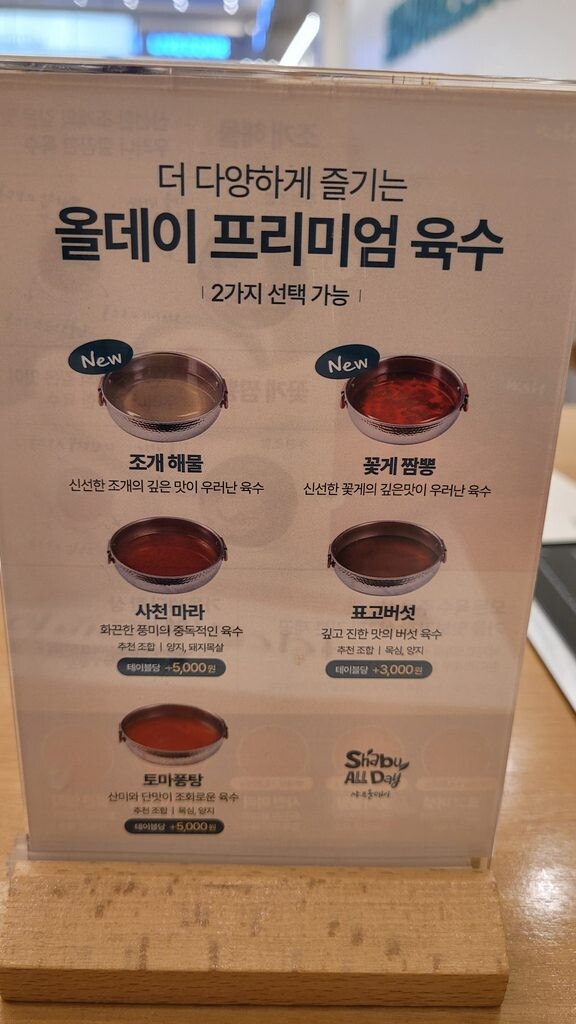
The pot is divided down the middle, so the two broths you pick never touch.
No surcharge:
| Broth | What it is |
|---|---|
| Signature brisket (the house pick) | Clean, plain beef broth |
| Spicy brisket | Beef with cheongyang chili heat |
| Clam and seafood | Shellfish depth, still clear |
| Blue crab jjamppong | Blue crab, and properly spicy |
With a surcharge — and this is charged per table, not per person:
| Broth | ||
|---|---|---|
| Shiitake mushroom | Deep, dark mushroom broth | +₩3,000 (about $2.20) |
| Sichuan mala | Numbing and hot | +₩5,000 (about $3.70) |
| Tomato tomapungtang | Sweet and sour | +₩5,000 (about $3.70) |
Per table matters. With four people the mala broth adds about ninety cents each.
The sign also prints pairings: mala with brisket or pork neck, shiitake and tomato with pork collar or brisket.
If you want one recommendation: take one clear broth and one spicy. The clear one is where you taste the meat and vegetables; the spicy one is where you finish with noodles. Two spicy broths and everything tastes the same by minute fifty.
The free seafood plate, and the one you pay for
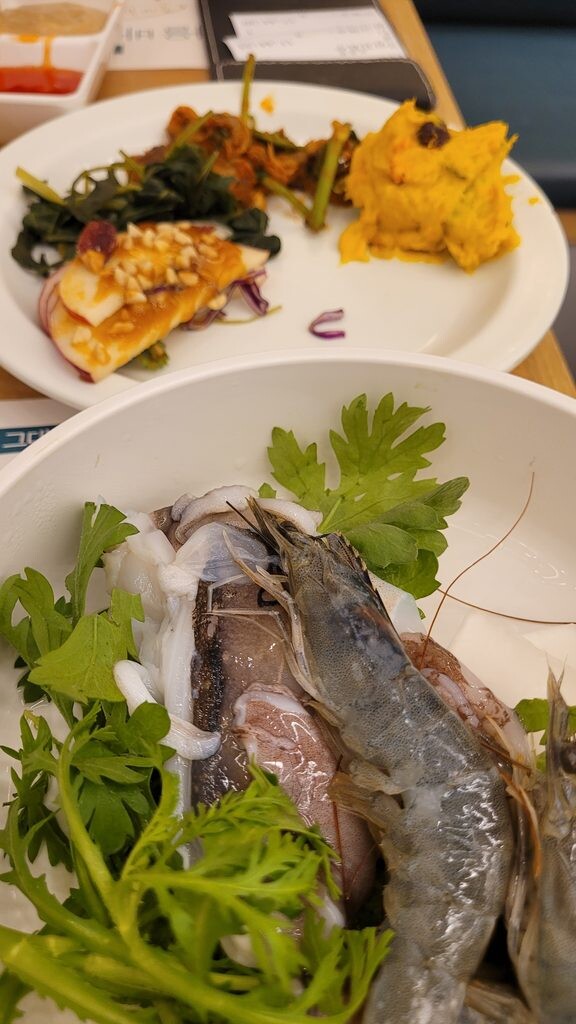
This one is easy to get confused, so read the two rows carefully.
| What’s on it | Price | |
|---|---|---|
| Autumn tasting plate | ½ octopus · ½ cuttlefish · 2 shrimp · radish · crown daisy | Free |
| Autumn sea plate | 1½ octopus · ½ cuttlefish · 2 shrimp · radish · crown daisy | +₩4,900 (about $3.65) |
Every broth order comes with the free tasting plate, one per two adults. The paid version is the same plate with one more octopus on it. That’s the whole difference, and ₩4,900 is what the octopus costs.

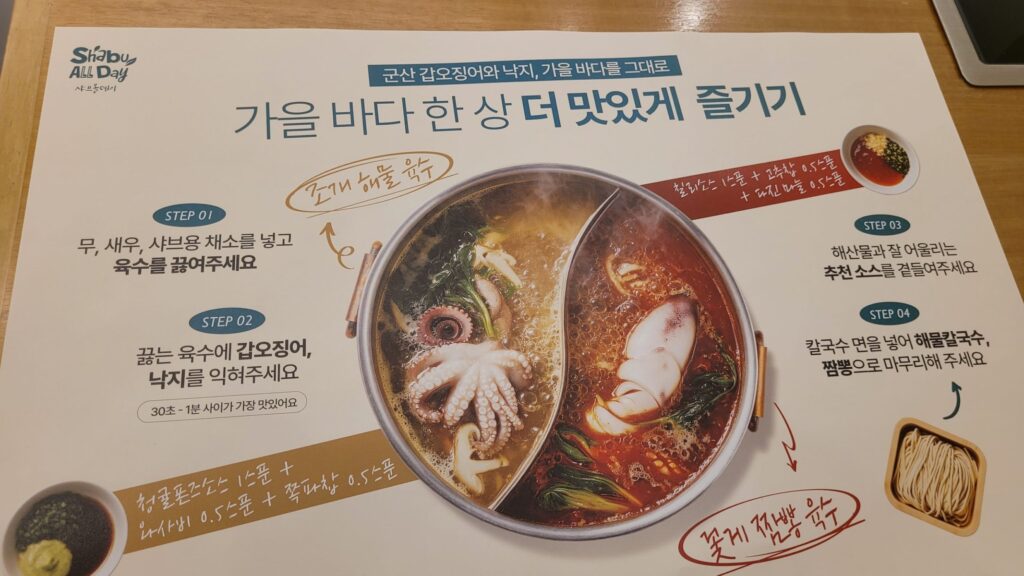
The table mat prints the cooking order, which I appreciated:
- Radish, shrimp and vegetables in first — they build the broth
- Cuttlefish and octopus: 30 seconds to one minute. No longer
- Sauce
- Kalguksu noodles at the end, as seafood noodle soup or jjamppong
Thirty seconds to a minute is not a suggestion. Octopus — nakji, NAHK-ji — goes from tender to rubber fast, and in a shared pot it’s easy to lose track of. Put it in, count, take it out.
The meat is self-serve
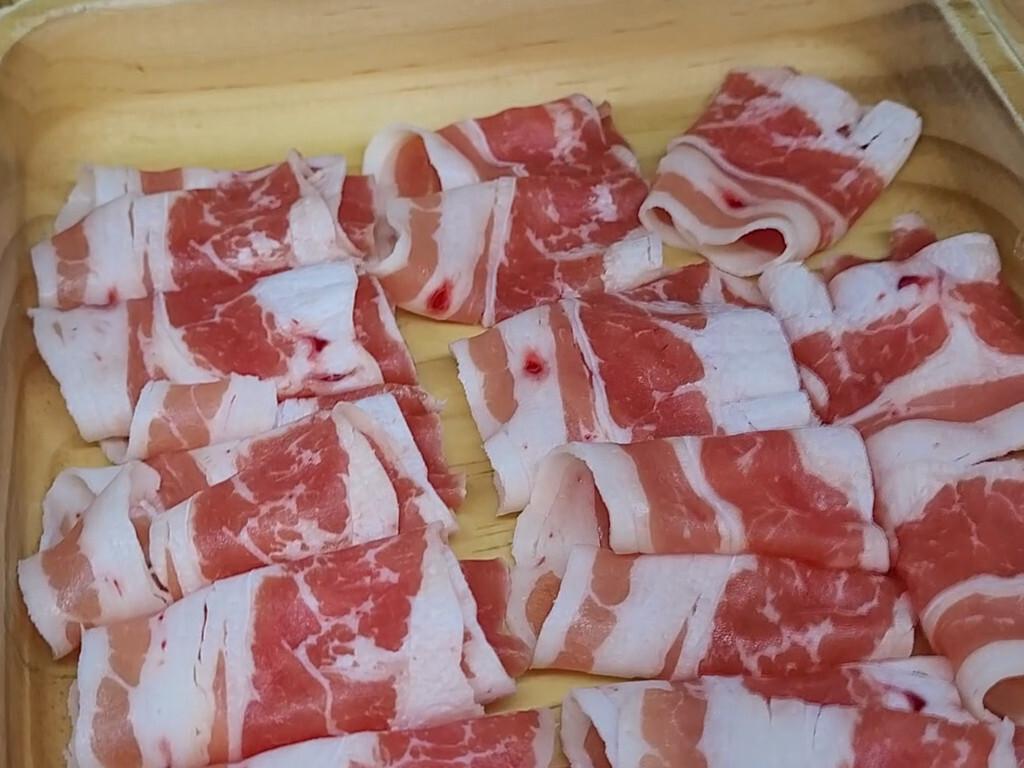
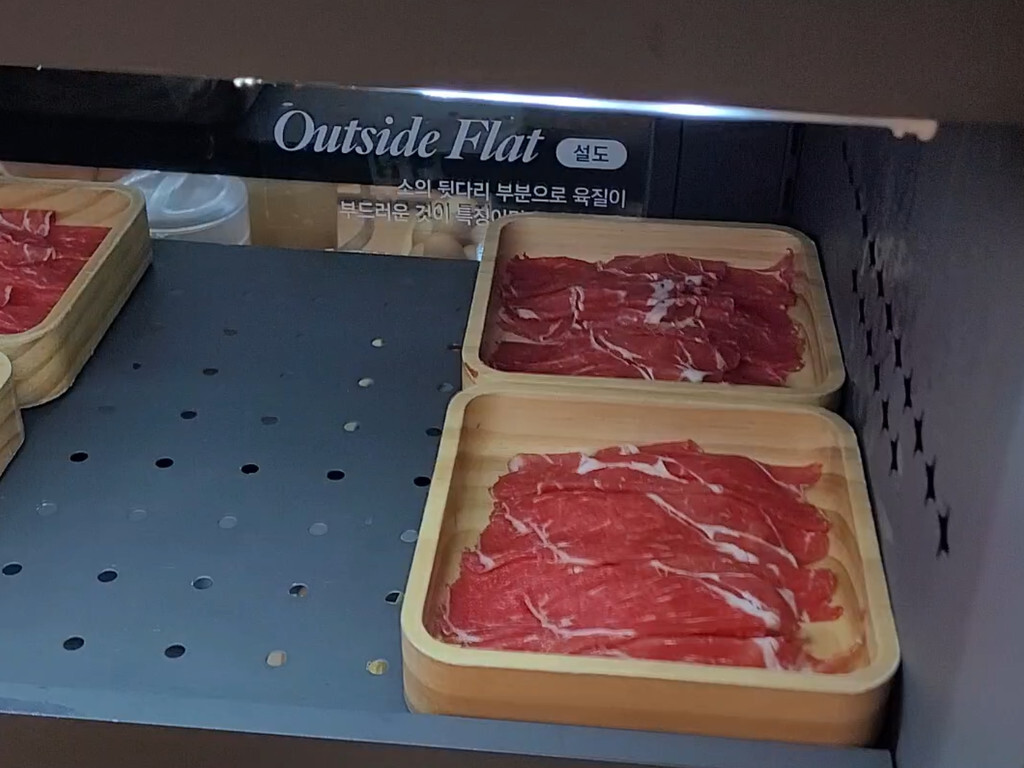
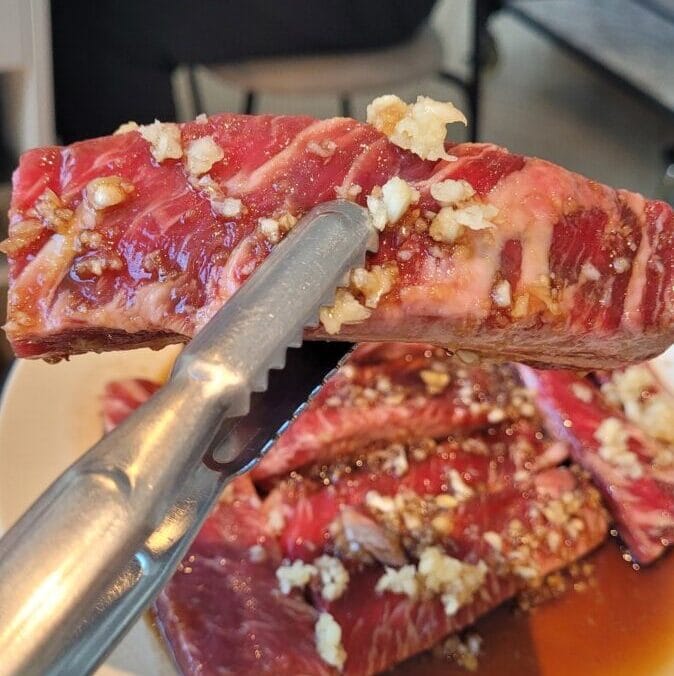
Beef and pork sit at the salad bar on ice, and you carry them back on a wooden tray. The beef is thin marbled shabu cut. Both get refilled as they run down.
Nobody brings it to you and nobody is counting how many trips you make.
The salad bar is the actual restaurant
This is where an ₩24,900 buffet is won or lost, and this one is stocked properly.
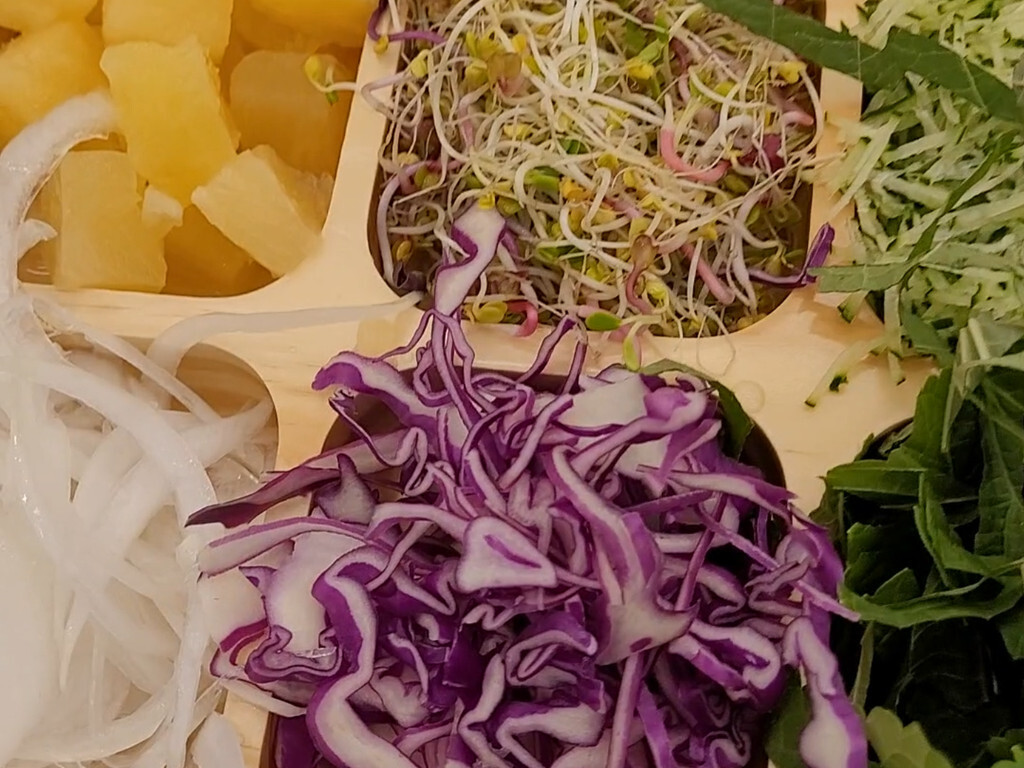
Vegetables — bok choy by the handful, napa cabbage, bean sprouts, crown daisy on the stem, and red-stemmed chard.
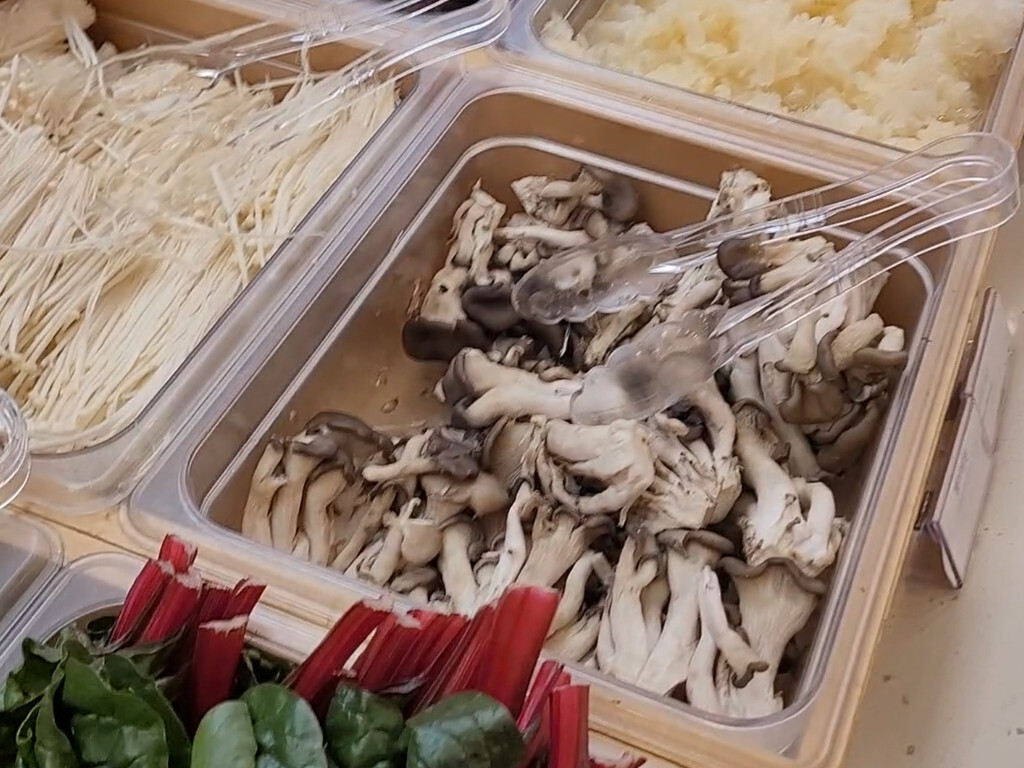
Mushrooms — oyster, enoki, and both black wood ear and white wood ear.


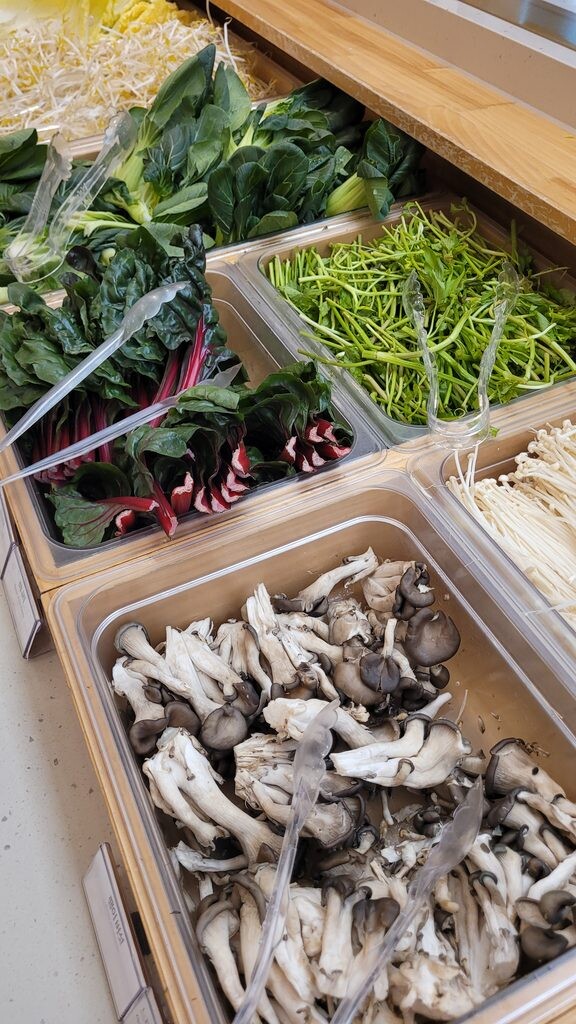
Having both wood ears out is unusual. They’re different textures — black is firm and slightly snappy, white is softer and more gelatinous — and putting both in the pot is better than doubling up on either.
Sari — SAH-ree — is the Korean word for the starch you add to a hot pot, and it has no clean English equivalent. Here the sari station has kalguksu noodles, udon, somyeon, flat dangmyeon, regular dangmyeon, dried tofu skin, fried tofu pockets, rice cake ovals, tteokbokki rice cakes, dumplings and meatballs.


If you ordered the seafood plate, finish with the kalguksu. That’s what the mat tells you to do and it’s right.
The perilla oil makguksu station
This is the thing I didn’t expect.
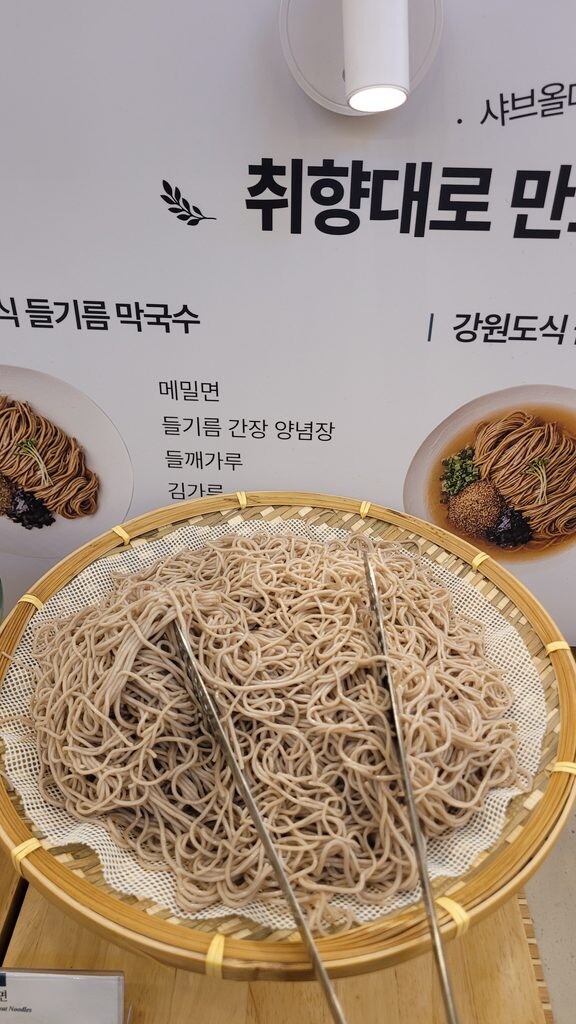

Off to one side of the salad bar there’s a basket of buckwheat noodles and a recipe taped to the wall. You build your own makguksu — mahk-GOOK-su — a cold Gangwon-province buckwheat noodle dish, from components:
| What goes in | |
|---|---|
| Perilla oil water makguksu | Buckwheat noodles + dongchimi (dong-CHI-mi, radish water kimchi brine) + seaweed flakes + perilla oil + pickled radish + scallion |
| Perilla oil mixed makguksu | Buckwheat noodles + green apple chili sauce + seaweed flakes + perilla oil + pickled radish + scallion |
The seasonings sit out in their own containers: perilla oil soy seasoning, green apple spicy sauce, ground perilla seed, seaweed flakes.
Perilla oil — deulgireum, DUHL-gi-reum — is pressed from perilla seed and tastes nothing like sesame oil. Nuttier, grassier, heavier. It’s having a moment in Korea right now and a cold bowl of noodles slicked with it is the standard way to meet it.
I’ve been to a lot of shabu-shabu buffets and I have not seen a build-your-own makguksu station in one before. Practically, it’s the reset button. Forty minutes of hot pot and your palate goes flat; a cold bowl of buckwheat and perilla oil brings it back.
The hot food counter, for people who didn’t want hot pot
There’s a separate counter of finished dishes, which exists mostly so that nobody at the table is stuck:
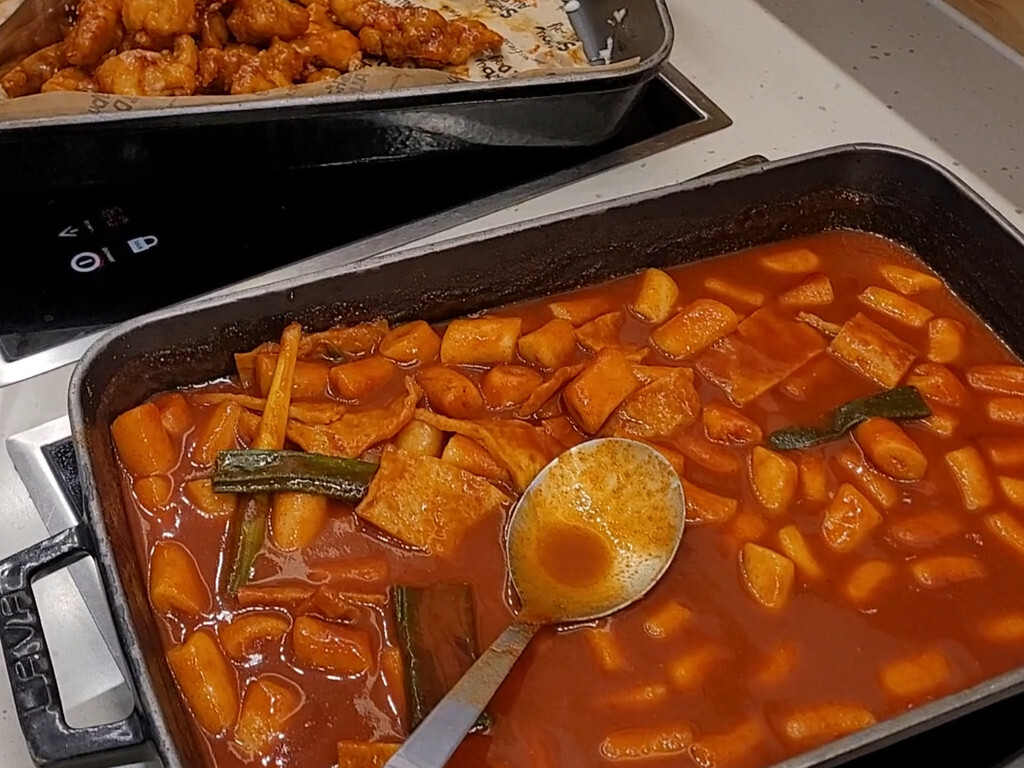
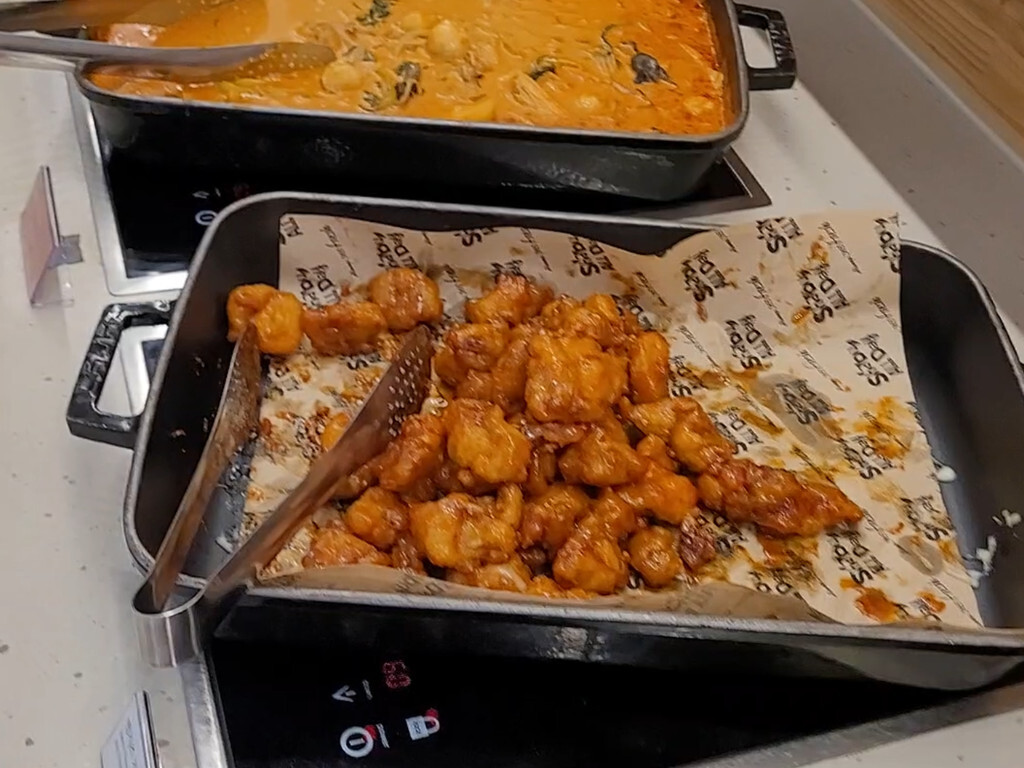

Rosé malaxiangguo (seasonal) · fried chicken in sweet sauce · sweet and sour pork and other fried things · french fries · fried noodles · tteokbokki · cheese butter chips
If you’re bringing children who won’t cook their own food in a pot of broth, this counter is the reason the meal works.
Over ten sauces, with ratios printed
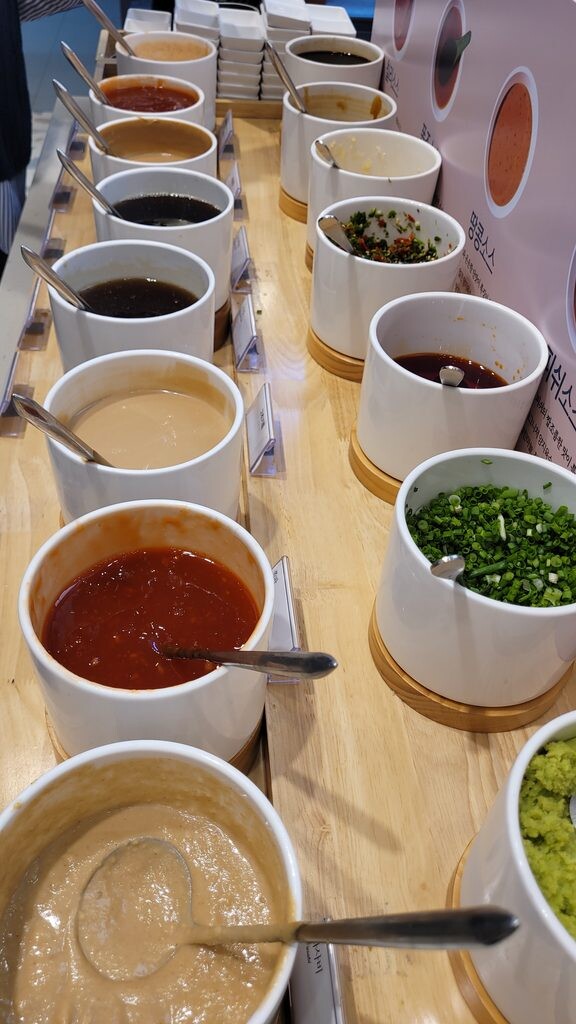
The sauce bar runs to more than ten: peanut, ponzu, wasabi, scallion relish, chili relish, chili sauce, minced garlic and the rest.
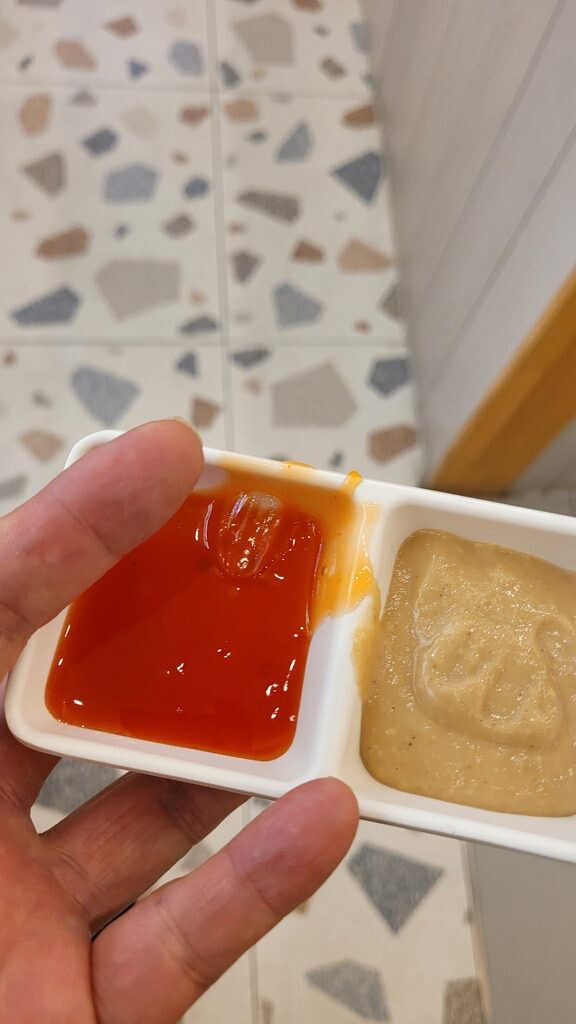

What’s unusual is that the broth sign prints mixing ratios.
| Broth | Suggested sauce |
|---|---|
| Clam and seafood | Green citrus ponzu 1 + scallion relish ½ + wasabi ½ |
| Blue crab jjamppong | Chili sauce 1 + chili relish ½ + minced garlic ½ |
In spoons. You don’t have to stand there guessing.
The beer is free

Unlimited draft, from a bottom-filling tap system, normally ₩2,000 — included here at no charge.
An all-you-can-eat meal at $18.50 with unlimited draft beer is not a thing that exists in the United States, because alcohol is where an American buffet makes its margin. Here it’s thrown in.
Two notes. You order it from a server — it isn’t self-serve, which surprises people given how much else in a Korean restaurant is. And if you’re driving, obviously not. Korea’s blood alcohol limit is 0.03%, which is roughly one drink, and enforcement is not casual.
How to spend eighty minutes
If you go at weekday lunch, the clock is tight enough to be worth a plan.
| Minute | Do this |
|---|---|
| 0–2 | Sit down, order both broths immediately. The pot starts heating while you’re gone |
| 2–10 | Salad bar. Vegetables and mushrooms first, meat second, sari last |
| 10–15 | Radish, shrimp and vegetables into the pot. Let it come up |
| 15–45 | Meat in small batches. Octopus and cuttlefish 30–60 seconds only. Refill vegetables as you go |
| 45–55 | Makguksu break. Cold noodles, reset the palate |
| 55–70 | Second round — different broth side, hot counter if you want it |
| 70–80 | Kalguksu into the remaining broth. Finish there |
The single mistake to avoid: filling the pot. Korean hot pot works in small batches, where you cook, eat, and add again. A pot stuffed to the rim is a pot of boiled vegetables.
📍 How to get there
샤브올데이 평택소사벌점 경기 평택시 만세로 1662 A동 (죽백동 424-3)
Screenshot that Korean address. Show it to a taxi driver and you’re done — it beats trying to pronounce it, and it works with no data connection.
| Hours | 11:00–21:30 (last order 20:30) |
| Phone | 0507-1370-4706 · 031-654-4706 |
| Parking | Large free lot in front of the building |
Parking is genuinely not an issue here — the frontage is all lot. If you’re driving in Korea for the first time, this is the easy kind of place.
One honest gap: the break time and closing days are not clearly published anywhere. Reviews mention a weekday break from 15:00 to 17:00 and no break on weekends, but I couldn’t confirm either. Call before you go. Staff may not speak English — if you’re calling from Camp Humphreys, have a Korean colleague make the call, or use a translation app and keep it to the date and time.
If you’re coming from Camp Humphreys


Most restaurant guides to Korea are written for people visiting for two weeks. This one has a different audience available to it, because Pyeongtaek is where Camp Humphreys is — the largest US military base outside the United States, with soldiers, families, civilians and contractors numbering in the tens of thousands.
If you’re stationed here, this isn’t a destination restaurant. It’s a weeknight option about twenty minutes away, in a part of the city with parking, where a family of four eats for roughly seventy-five dollars at lunch.
The things to know are the three on the sign: the clock, two people minimum, and that your seventh grader is an adult.
What I’d tell you before you go
You can’t come alone. Two minimum, stated at the door.
Middle school is adult price. A family of four with two middle schoolers pays four adult prices, not two and two.
Eighty minutes at weekday lunch is tight. Not unworkable, but you need the plan above. If you want to take your time, pay the extra ₩5,000 for dinner and get the extra twenty minutes.