A Korean meal arrives with five or six small dishes around it. Seasoned greens, pickled radish, braised fish, something cold and crunchy. Nobody ordered them. Nobody will charge for them. If you finish one, somebody brings more.
They’re called banchan — say it BAHN-chahn — and every English article about Korean food describes them the same way: this is the labour-intensive part of Korean cooking.
Which is true, and leaves out the half that matters.
Most Korean homes buy a lot of them.
There’s a refrigerated case in any decent Korean supermarket, usually past the meat and before the registers, filled with cooked side dishes in sealed trays. Each one is portioned, dated and priced. You pick up four, cook rice at home, and that’s dinner.
This is not a secret and it is not cheating. It’s the same shift that already happened with kimchi, where a quarter of Korean households now buy it rather than making it. The banchan counter is the rest of that sentence.
What banchan actually is

Banchan is not a type of food. It’s a position at the table.
Japchae served as one plated course at a formal restaurant is a course. The same japchae in a tray from the supermarket is banchan. Tteokbokki sold from a cart on the street is street food; tteokbokki that arrives free at a ssambap restaurant, on a proper plate, without being ordered, is banchan. The dish didn’t change. Its job did.
What’s never banchan: rice and soup. Those are the meal itself. Everything arranged around them is banchan.
Which brings up the thing English explanations almost always get wrong.
A three-dish table has nine dishes on it
The traditional name for a Korean table setting is bansang (BAHN-sahng), and it’s counted in units called cheop (chuhp) — a three-cheop table, a five-cheop table, a seven-cheop table. The royal version went to twelve.
Read that as “a three-dish meal” and you’d picture something sparse. It isn’t, because the count deliberately excludes the things that are always there:
Not counted: rice · soup · kimchi · the stew · the little saucers of soy sauce and vinegared chili paste.
So a three-cheop table — the plain everyday one, the modest end of the scale — puts around nine things in front of you. Three of them are banchan. The other six are simply assumed.
That’s the logic underneath the whole system. Banchan is the variable part. The base never moves, so the base doesn’t get counted, which is also why no restaurant itemises it on the bill. At the other end of the scale, an eleven-course hanjeongsik lunch is the same idea with the variable part run all the way up.
And in restaurants, banchan is free. Not a complimentary gesture — structurally free, refilled on request, and it stays in the middle of the table rather than in front of any one person.
Now: somebody has to make all of it.
What’s in the case, and what it costs


The counter in these photos is run by a company whose own label calls it a seasonal banchan specialist — the supermarket rents out the floor space, a food company runs the operation. That’s the normal arrangement.
| Price | USD | |
|---|---|---|
| Seasoned dried squid | ₩3,800 | about $2.80 |
| Bean sprout and vegetable sides | ₩3,800 | about $2.80 |
| Royal court japchae | ₩8,900 | about $6.50 |
| Bibimbap, assembled | ₩9,500 | about $7.00 |
| Braised mackerel in chili | ₩13,900 | about $10.20 |
| Fried tofu pockets stuffed with rice | — | — |

Japchae is the one to look at, because it’s the clearest case of what this counter is for. Made at home it’s a forty-minute job — noodles boiled, every vegetable cooked separately, the whole thing tossed at the end. Here it’s ₩8,900 and someone else did it. Plenty of Korean households make it from scratch for holidays and buy it the rest of the year.
Every label carries a pack date and a use-by date. The squid I photographed was packed on the 27th and good through the 10th — two weeks. These are made nearby and turned over fast, not shipped in and left to sit.
The fried counter

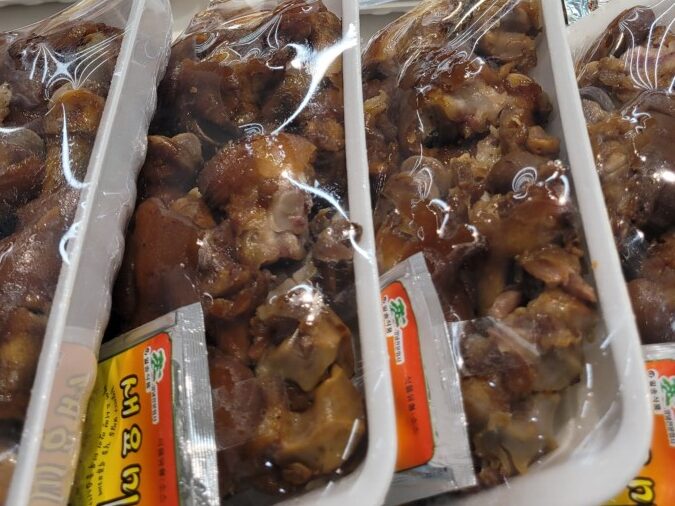
Next to the cold case there’s a hot one, and it’s a different proposition: not side dishes, but dinner with no cooking at all.
| Price | USD | |
|---|---|---|
| Whole fried chicken | ₩7,500 | about $5.50 |
| Braised pig trotter, sliced | ₩9,900 | about $7.30 |
| Breaded cutlets | ₩6,900 | about $5.10 |
| Tteokbokki | ₩5,900 | about $4.30 |
| Glutinous rice doughnuts | ₩5,500 | about $4.00 |
A whole fried chicken for five and a half dollars is the number that stops people. Korean delivery chicken from the big franchise brands crossed the ₩20,000 line years ago and kept going — it’s enough of a national sore point that the press has a phrase for it. Supermarket chicken exists because of that gap, and it is a genuine category here, not a sad substitute. It comes out of the fryer through the afternoon and sells out by evening.
The braised pig trotter — jokbal, JOK-bal — is worth noticing too. In Seoul this is late-night delivery food: pork slow-cooked in soy and aromatics, sliced, served cold with the gelatin still set. Here it’s on a shelf next to the yogurt, at a third of what it costs after midnight.
The fish is already grilled
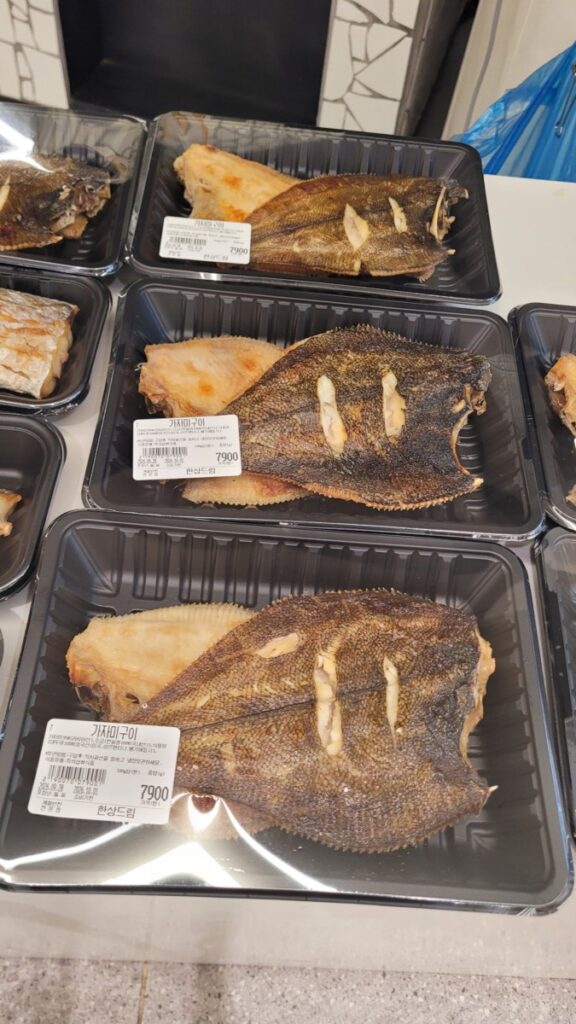
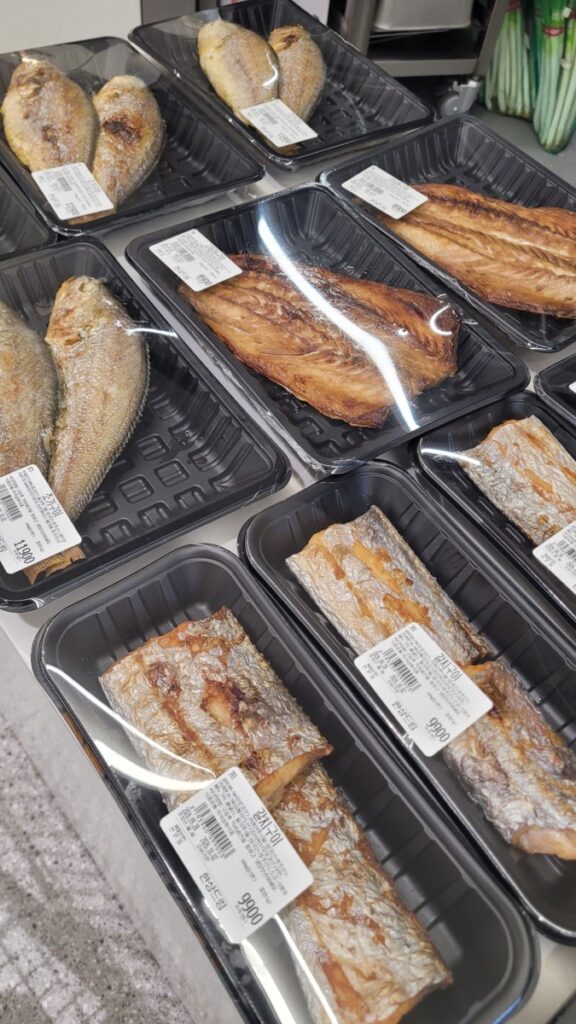
This is the part that only makes sense once you’ve lived in an apartment here.
There’s a section of mackerel, flatfish and atka mackerel, already grilled, boxed and chilled. Not raw. Not marinated. Cooked, and ready to eat cold or after thirty seconds in a microwave.
Grilled fish is standard on a Korean dinner table. Godeungeo (go-DUNG-uh), mackerel, is the everyday one.
The reason it’s sold cooked is the building. Most Koreans live in apartments, and grilling a mackerel in an apartment kitchen puts the smell through the whole unit — curtains, hallway, the neighbours’ landing — and it stays for a day or more. Plenty of people simply will not do it at home any more.
So the shop does it. You get the fish and the smell stays at the store.
It isn’t convenience food the way a frozen dinner is convenience food. It’s a solution to a specific problem that everyone in the country has, in the same building, at the same time of day.
How to use this if you’re visiting
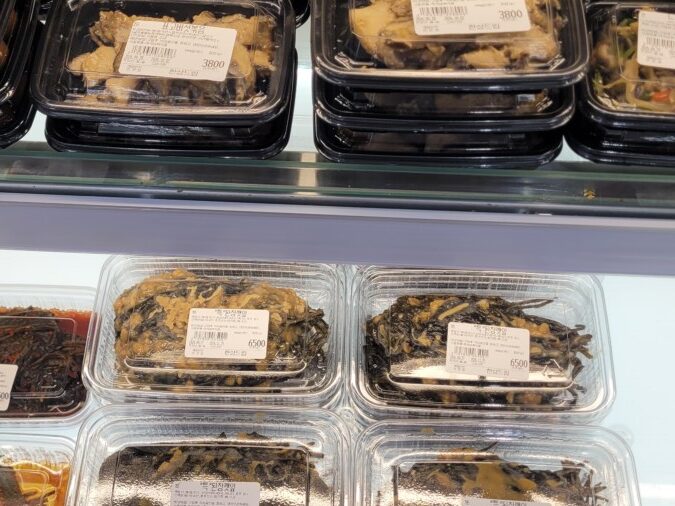
If you’re staying somewhere with a rice cooker — many guesthouses and almost every officetel rental have one — this counter is the cheapest good meal in the building. It beats the convenience store on both price and quality, and it isn’t close.
Rice, plus three trays, feeds two people for about ₩12,000. Under nine dollars.
What to pick the first time: one vegetable tray, one substantial thing (japchae, or the grilled mackerel), and one pickled or spicy one. That’s the shape of a Korean table — something plain, something rich, something sharp — and it works whether you cooked it or not.
A note on reading the labels. The big number at the bottom right is the price in won. The two dates above it are the pack date and the use-by date, in that order, written year-month-day. You don’t need to read anything else.