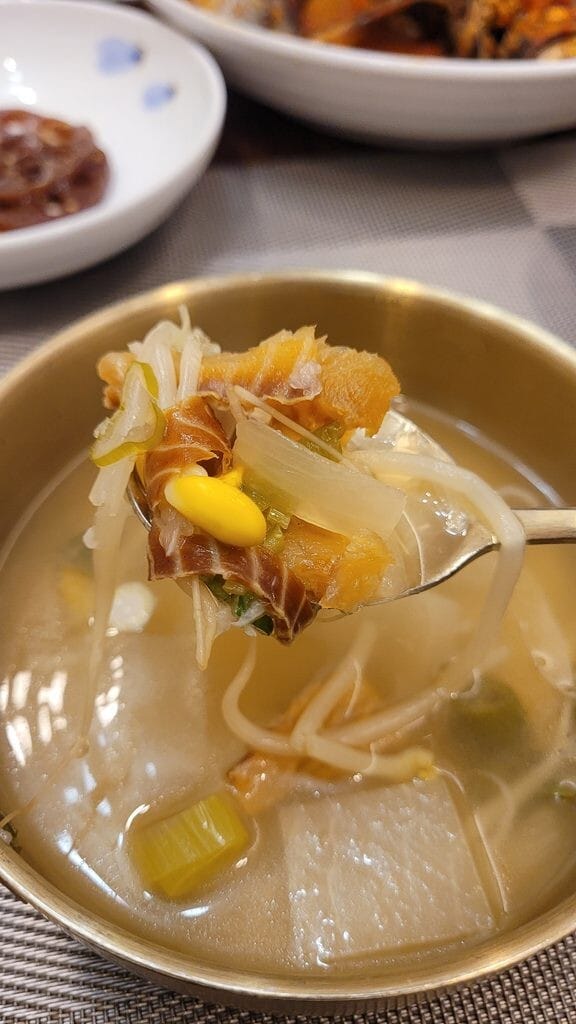
Most guides to eating in Asia get lumped together, and that’s where people go wrong in Korea.
Korean dining etiquette is not Japanese etiquette with different food on the table. The most common mistake proves it: lifting the rice bowl. In Japan you’re supposed to. In Korea you leave it down. Same region, opposite rule.
Here are the eleven that actually matter. None of them are hard, and getting them right changes how a meal goes.
1. Don’t lift the rice bowl
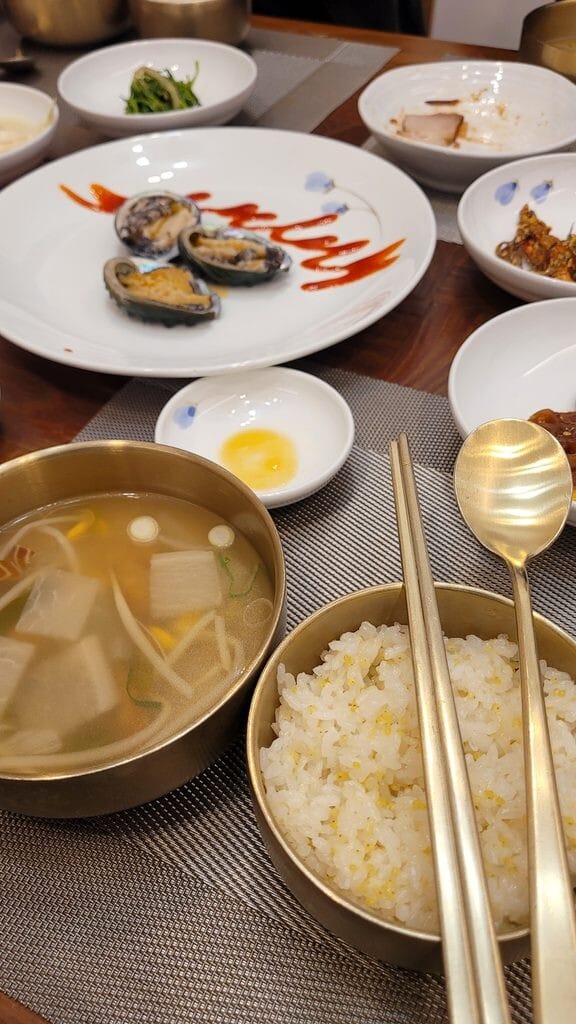
It stays on the table. You lean in slightly and bring food up to your mouth.
Historically this connects to the weight of Korean tableware — brass and stone bowls are heavy and hot — but the rule holds even with a light bowl. Lifting it reads as childish or, at a formal table, slightly rude.
Soup bowl too. Leave it down and use the spoon.
2. The spoon is for rice and soup. Chopsticks are for everything else.
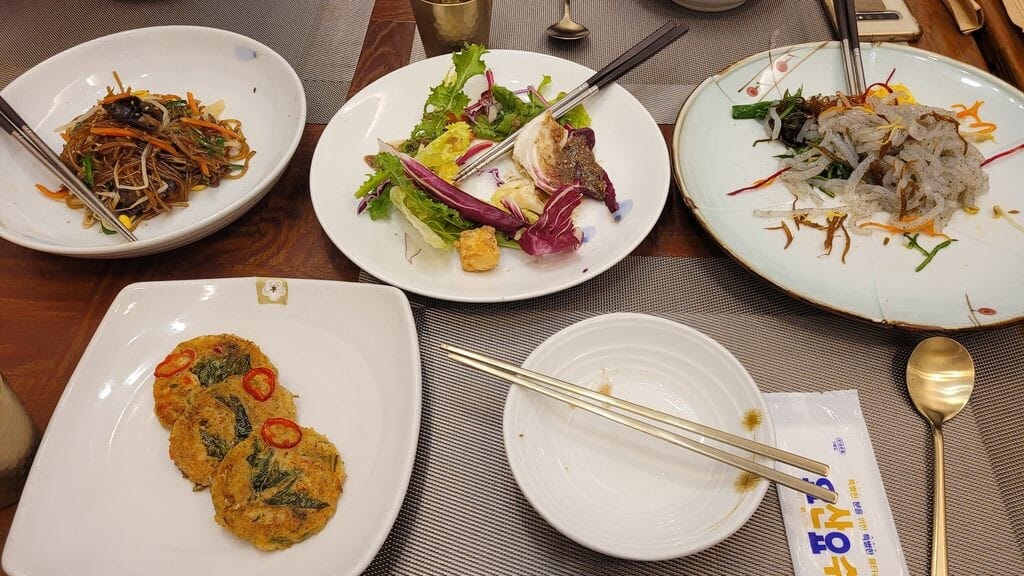
This is the division that surprises people most.
Korea is unusual in East Asia for how much work the spoon does. Rice gets eaten with the spoon. Soup gets eaten with the spoon. Everything on the shared plates — meat, vegetables, kimchi, pancakes — gets picked up with chopsticks.
Don’t hold both at once. One in your hand, the other resting on the table. Holding a spoon in one hand and chopsticks in the other looks, to a Korean, like someone who’s never eaten before.
3. Never stand chopsticks upright in rice
Two chopsticks planted vertically in a bowl of rice is how food is offered to the dead at a memorial rite.
Doing it at a dinner table isn’t a minor faux pas — it’s genuinely unsettling to see. Lay them flat across the edge of the bowl or on the table instead.
4. Banchan is shared, free, and refillable

The small dishes that arrive without you ordering them — kimchi, seasoned greens, braised things — are banchan (반찬, BAN-chan).
- Nobody ordered them and nobody is charging you
- They’re communal. Everyone eats from the same small dishes
- At most restaurants, refills are free. Ask, or hold up the empty dish
- They’re not an appetizer. Eat them with the rice, through the whole meal
Don’t take a banchan dish and set it in front of yourself. It stays in the middle.
5. Wait for the oldest person to start
At a table with any age range, the eldest lifts their spoon first. Everyone else follows.
It takes about four seconds and nobody will explain it to you. Just watch and follow. The same applies at the end — people tend not to leave the table until the eldest is done.
If you’re the only foreigner at a work dinner, this one rule will do more for you than anything else on this list.
6. Never pour your own drink
Somebody else pours for you; you pour for them. Keeping an eye on your neighbor’s empty glass is part of the meal.
When receiving from someone older or senior: hold your glass with both hands, or with your right hand and your left hand touching your right forearm.
When drinking in front of someone much older: turn your head away from them as you drink. It looks odd the first time. It’s a real thing.
When pouring for someone older: two hands on the bottle.
Nobody will be offended if you forget. Getting it right, though, gets noticed.
7. You don’t have to drink
Soju arrives in groups and refusing feels awkward, but “I don’t drink” is accepted without much fuss these days, and a lot more common among young Koreans than the stereotype suggests.
Take the pour, touch the glass, leave it. That’s usually enough.
8. Call the server. It’s not rude.
Korean restaurants don’t do the hovering American server. Nobody is coming to check on you.
- Many tables have a call button. Press it
- If not, say “저기요” (juh-GI-yo) at a normal volume. It means roughly “excuse me”
- Raising your hand also works
Sitting quietly hoping to catch someone’s eye is how you end up waiting twenty minutes for water that was free and self-serve the whole time.
9. Water, cups and utensils are usually self-serve
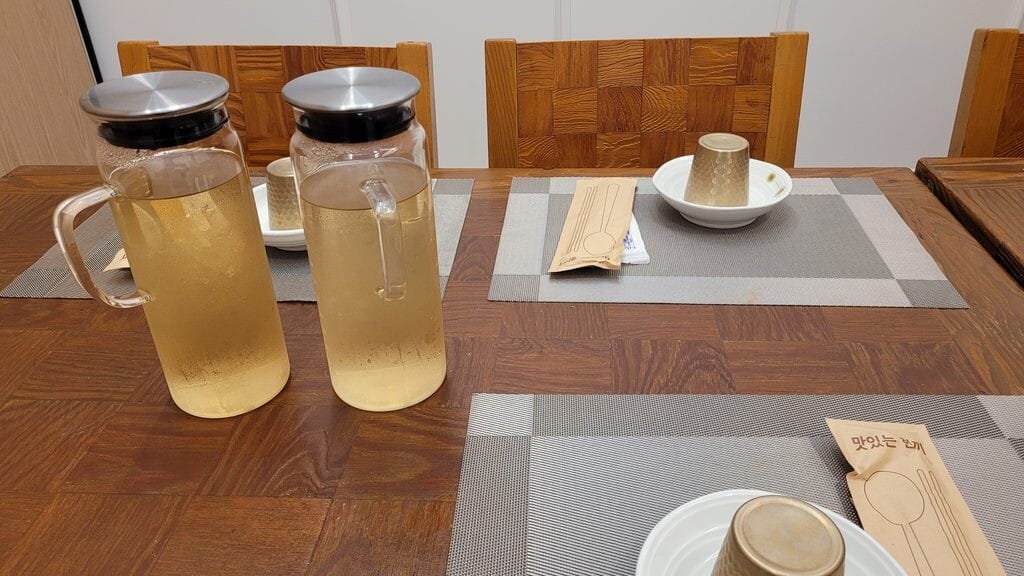
Look for a station near the counter, or a drawer under the edge of your table — many Korean tables have cutlery in a drawer you pull out yourself.
Water is free and always comes cold or as roasted barley tea. You will not be charged for it and you do not order it.
10. Eating sounds are fine. Nose-blowing is not.
Slurping noodles, audible chewing, the sound of a hot spoonful — all normal.
Blowing your nose at the table is not. Korean food is spicy enough that this comes up constantly. Turn away and do it quietly, or step out.
11. There’s no tipping. At all.
Not at restaurants, not at cafés, not for delivery. Service charges are already in the price.
Leaving money on the table will usually get you chased down the street by someone returning it.
Two more things worth knowing
Who pays. Traditionally the eldest, or whoever invited. Splitting the bill is now completely normal among younger Koreans, and most restaurants will split the payment across cards without complaint. If someone older insists on paying, a light protest and then thanks is the right shape.
Shoes. Some traditional restaurants have floor seating on a raised platform. Shoes come off before you step up — there are shelves at the edge. Wear socks you’re willing to be seen in.
Quick reference
- Rice bowl stays on the table. Don’t lift it
- Spoon for rice and soup, chopsticks for everything else. Never both at once
- Never stand chopsticks upright in rice
- Banchan is shared, free, refillable, and eaten with the rice
- Wait for the eldest to start
- Never pour your own drink. Two hands when receiving from an elder
- Call the server — button, or “저기요” (juh-GI-yo)
- Water and utensils are self-serve. Check the drawer under the table
- Slurping is fine. Nose-blowing at the table isn’t
- No tipping, anywhere
None of these are tests. Koreans eating with a foreigner expect the rules to be unknown and nobody is keeping score.
But the meal goes differently when you know them.