We ordered the lunch set. It came to ₩21,000 a person — about $15.
On the way out I looked at the menu again, because something hadn’t added up.
The galbi by itself is ₩20,000. The soup by itself is ₩11,000. That’s ₩31,000. The lunch set is both of those things, and it’s ₩21,000.
Ten thousand won just disappears.
The Korean BBQ lunch special is a national rule, not a coupon
This is the single most useful thing to know about eating meat in Korea, and almost nothing written in English mentions it.
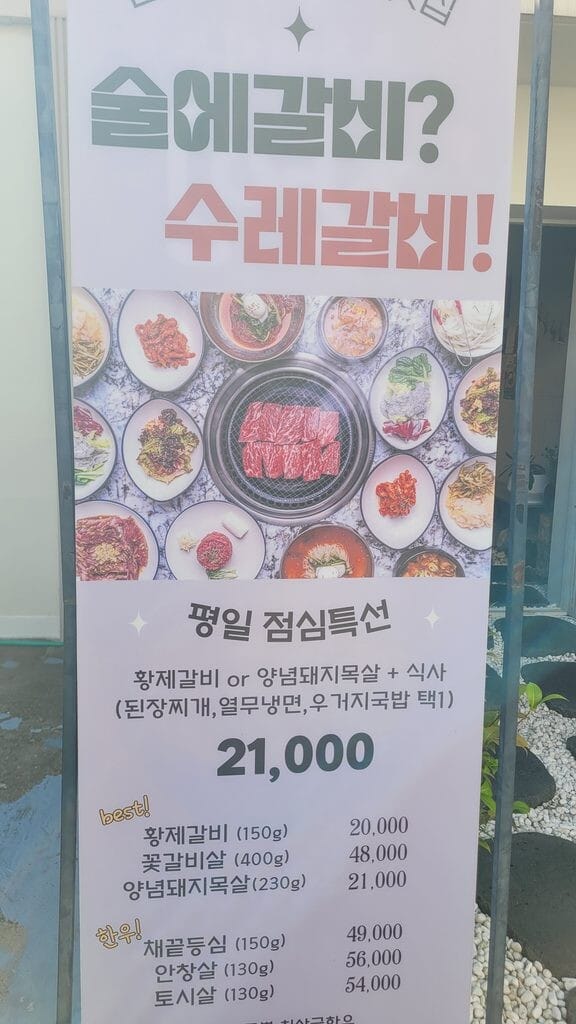

Jeomsim-teukseon (점심특선) — say it JUM-shim TUK-sun — means “lunch special.” Nearly every serious Korean meat restaurant runs one. It is not a promotion that ends next month. It is how the business is built.
Places like this make their money at night, when tables turn into three-hour sessions with soju. Lunch is dead capacity — the room exists, the coals exist, the staff are already there. So they sell lunch close to cost to fill the seats, and they discount it by bundling: grilled meat plus a rice or noodle dish, one price, roughly a third off.
If you are visiting Korea and want to eat well without spending much, eat your big meals at lunch. That’s the whole strategy. The same restaurant, the same kitchen, the same meat — priced completely differently depending on what time you walk in.
Two rules trip people up:
- Weekdays only. Saturday is dinner pricing all day.
- Minimum two orders. You cannot get the lunch special alone. This one catches solo travelers constantly.
What ₩21,000 buys at this one
Surae Galbi (수레갈비 — SOO-reh GAL-bee) is in Sangam, in western Seoul. You pick one of two lunch sets, both ₩21,000:
| Lunch set (weekdays, 2+ orders) | Price | USD |
|---|---|---|
| Emperor galbi, 150 g + rice dish | ₩21,000 | about $15.40 |
| Marinated pork shoulder, 230 g + rice dish | ₩21,000 | about $15.40 |
The rice dish is your choice of three: doenjang-jjigae (soybean paste stew), naengmyeon (cold noodles), or ugeoji-gukbap (cabbage-and-beef soup over rice).
Here is the same food, ordered à la carte:
| Separately | Lunch set | You save | |
|---|---|---|---|
| Emperor galbi 150 g + soup | ₩20,000 + ₩11,000 = ₩31,000 | ₩21,000 | ₩10,000 (about $7.35) |
| Pork shoulder 230 g + soup | ₩21,000 + ₩11,000 = ₩32,000 | ₩21,000 | ₩11,000 (about $8.10) |
There is no reason to order à la carte at lunch. None.
They mix the marinade when you order
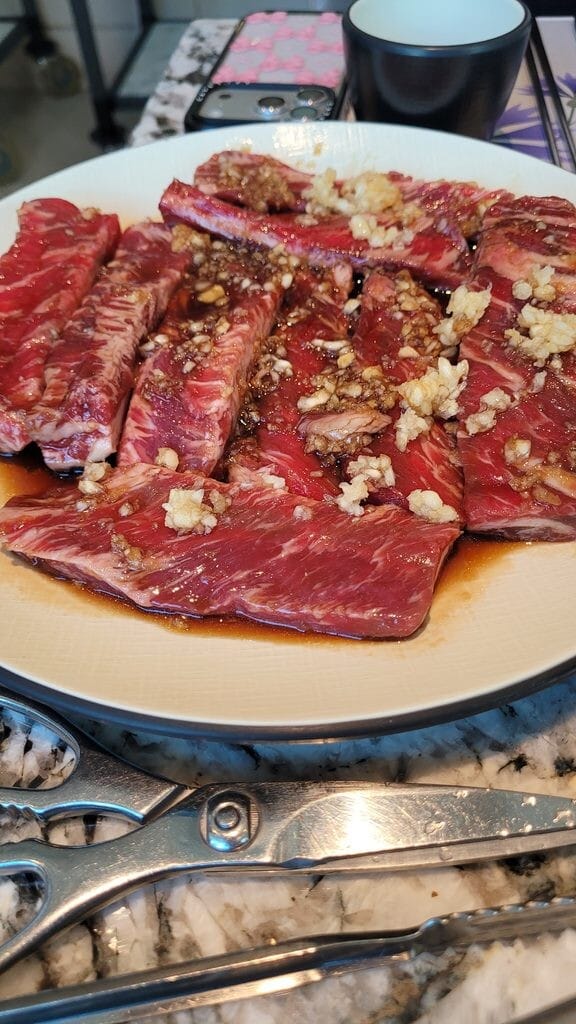
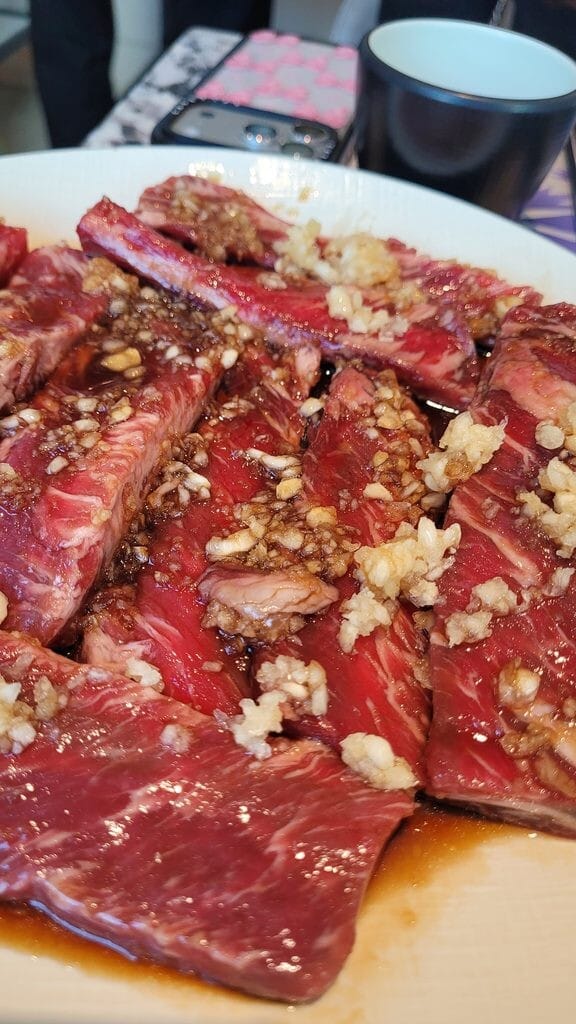
The galbi arrived and I thought it hadn’t been marinated properly.
Minced garlic was sitting raw on top. Soy marinade pooled in the dish instead of soaking in. The meat was still visibly red.
Then I read the menu. It says the marinade is mixed the moment you order — not the night before.
That explains the taste. Galbi that’s been sitting in marinade for a day has sugar and salt driven all the way into the meat, and those arrive first. Here the beef arrives first and the marinade follows it. Soy saltiness, then garlic, and only then a little sweetness underneath.
It is a lighter version of a dish most people know as a heavy one.
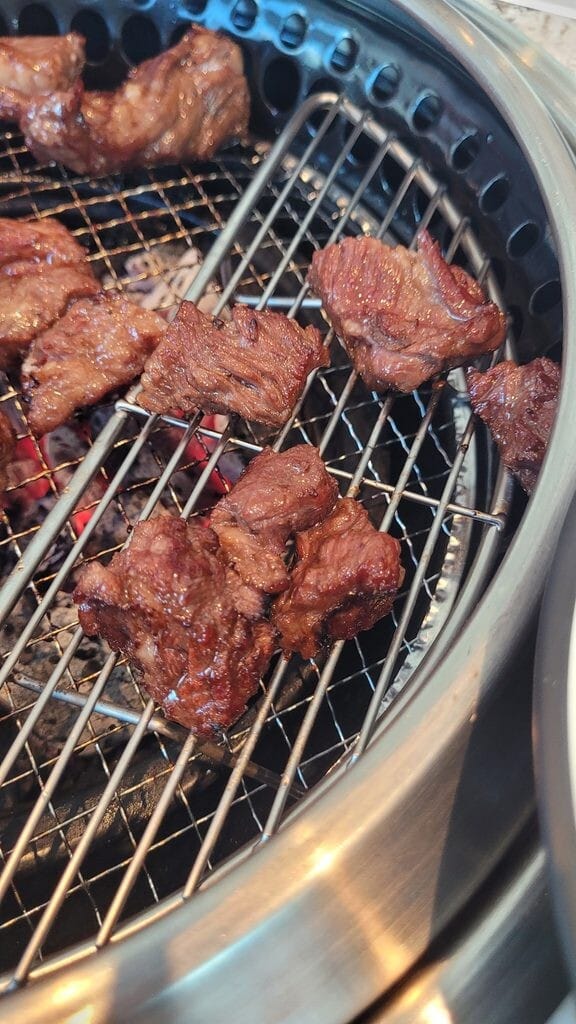
Real charcoal, and somebody else does the grilling
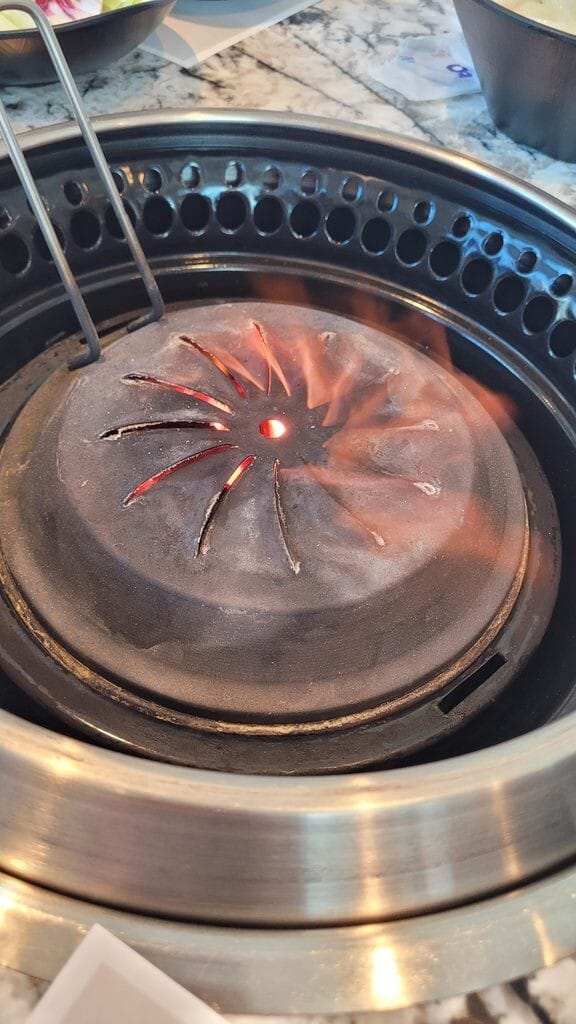
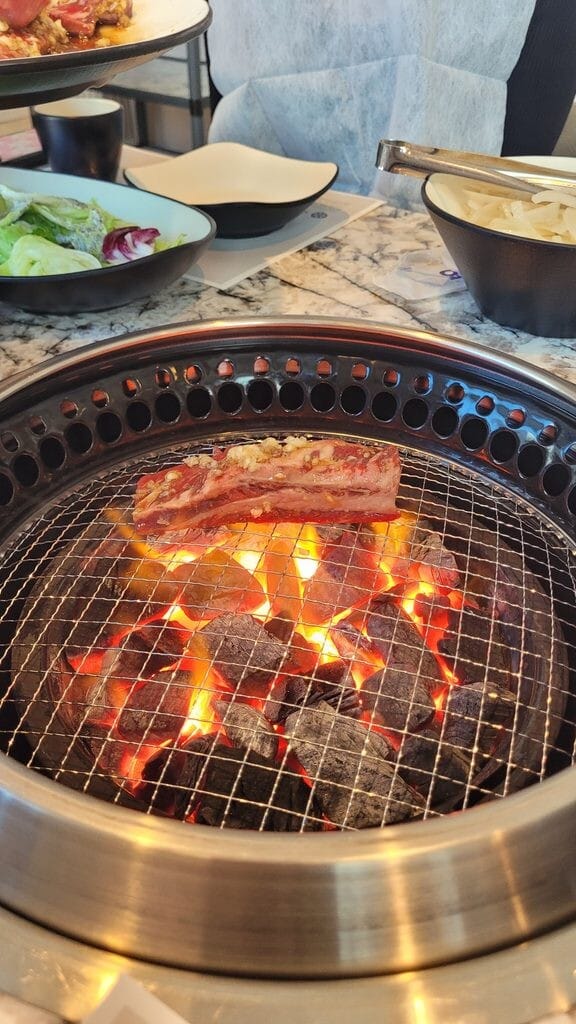
Sutbul (숯불 — SOOT-bul) means charcoal fire, and here it is literal. A staff member brings a cast-iron pot of already-burning coals to your table and sets it into the grill well. The lid comes off and you are looking at live orange charcoal. The grate goes on top of that.

Then they grill it for you.
Stop on that for a second if you have never eaten Korean barbecue. At most places the meat arrives raw and the table is yours to run — which piece goes on first, when to turn it, when to cut it, when to take it off. That’s part of the pleasure once you know what you’re doing. The first time, in a language you can’t read, over meat you have already paid for, it is mostly stress.
Here you don’t touch the tongs. Someone who does this all day stands at your table, grills, turns, cuts, and tells you when to eat. For a first Korean barbecue, that is worth more than it sounds.
It matters more with this meat than most. The galbi is cut thin and the fire is hard, so it cooks in well under a minute a side — which is exactly the window a beginner misses.
What the charcoal gets you is smoke. Marinade drips onto the coals, comes back up as smoke, and lands on the meat. Gas grills cannot do this. It’s the difference between grilled meat and barbecue.
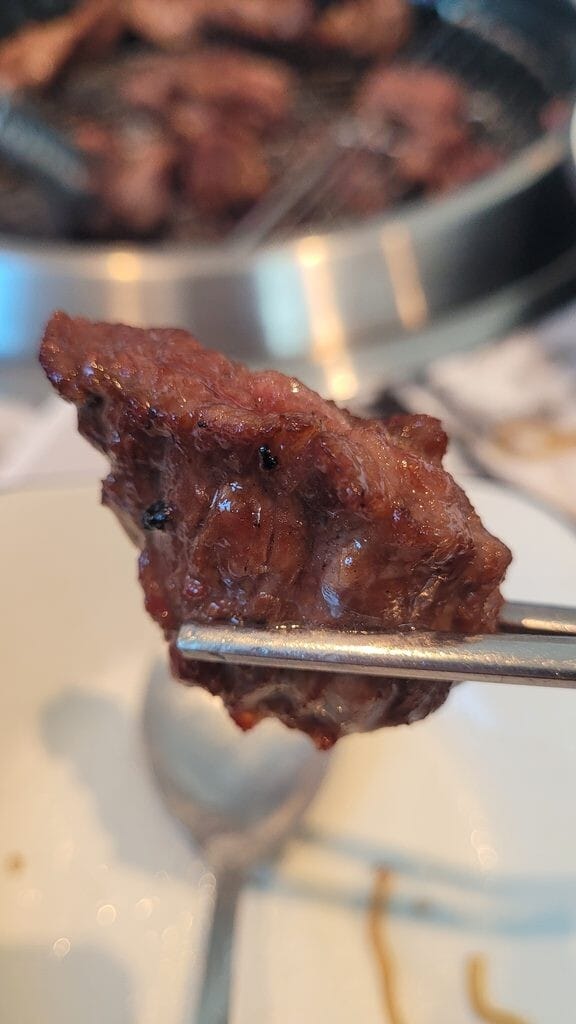
Cooked, the edges go dark and glossy where the sugars caught. The marbling shows clearly when you lift a piece — thin white lines all the way through.
The menu prints the price per 100 grams
This is the part I’d want to know about before going anywhere else.
Korean meat menus normally list a weight and a total. 150 grams, ₩20,000. To compare two cuts you have to do arithmetic at the table, which nobody does.
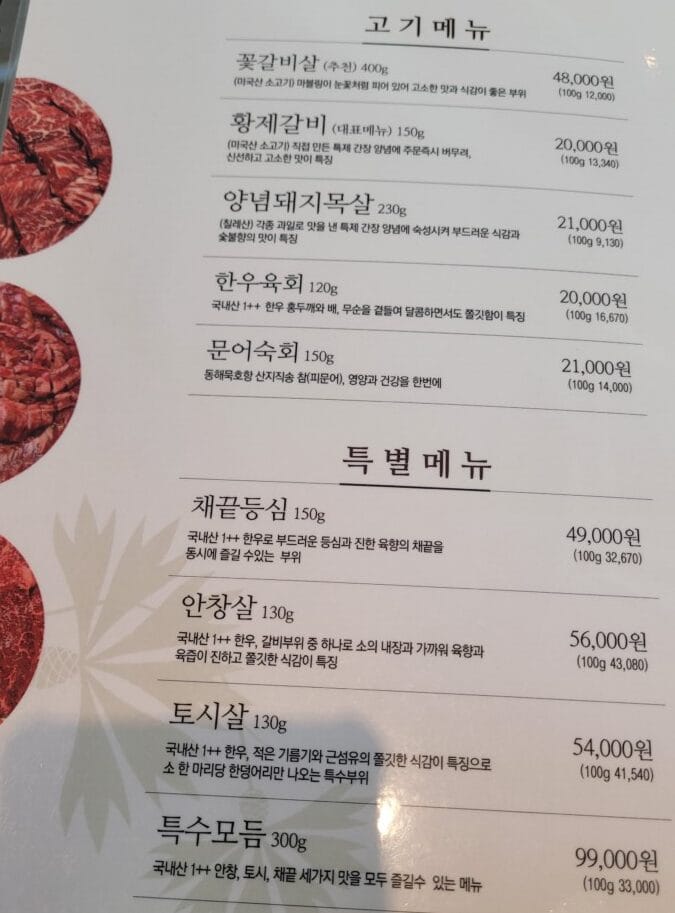
This menu prints the per-100-gram price in parentheses next to every single cut. The restaurant did the math for you, which means it is inviting you to compare — including against the place down the street.
| Cut | Weight | Price | Per 100 g |
|---|---|---|---|
| Marinated pork shoulder (Chile) | 230 g | ₩21,000 | ₩9,130 / $6.71 |
| Boneless short rib (USA) | 400 g | ₩48,000 | ₩12,000 / $8.82 |
| Emperor galbi (USA) | 150 g | ₩20,000 | ₩13,340 / $9.81 |
| Poached octopus (Mukho port) | 150 g | ₩21,000 | ₩14,000 / $10.29 |
| Beef tartare (Korean 1++) | 120 g | ₩20,000 | ₩16,670 / $12.26 |
| Striploin (Korean 1++) | 150 g | ₩49,000 | ₩32,670 / $24.02 |
| Premium cuts platter (Korean 1++) | 300 g | ₩99,000 | ₩33,000 / $24.26 |
| Outside skirt (Korean 1++) | 130 g | ₩54,000 | ₩41,540 / $30.54 |
| Skirt steak (Korean 1++) | 130 g | ₩56,000 | ₩43,080 / $31.68 |
And once the numbers are in front of you, you can see things.
Order the three premium Korean cuts separately — striploin, skirt, outside skirt — and it’s ₩159,000 for 410 grams. That’s ₩38,780 per 100 g.
The premium platter is 300 grams for ₩99,000. ₩33,000 per 100 g. Nearly ₩6,000 cheaper per 100 grams, about $4.25.
If you want to taste all three, the platter is the answer, and the menu board is what tells you so.
The three rice dishes, all of them
We ordered one of each so we could see the whole set.
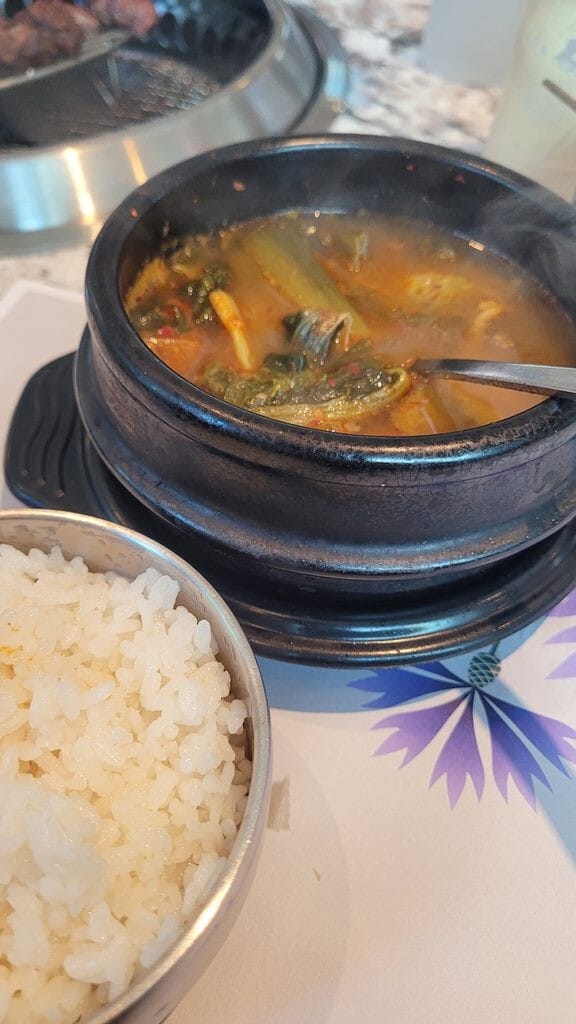
Ugeoji-gukbap (옛날 우거지국밥 — OO-guh-jee GOOK-bap), ₩11,000 à la carte. Beef-bone broth with a lot of outer cabbage leaves, and shreds of beef that come up when you dig. Clean broth, cabbage cooked soft enough that it isn’t stringy. This is the one to order. After grilled meat it resets your mouth.
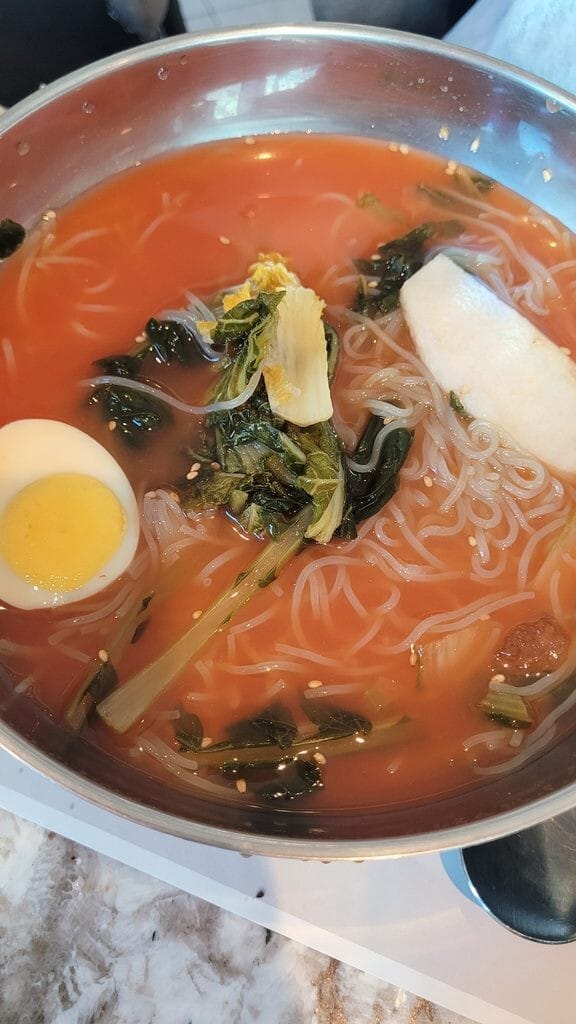
Yeolmu-naengmyeon (열무냉면 — YUL-moo NENG-myun), ₩9,000. Cold noodles in a red, sour broth made from young summer radish. Half a boiled egg, radish, greens. Thin noodles. A summer order.
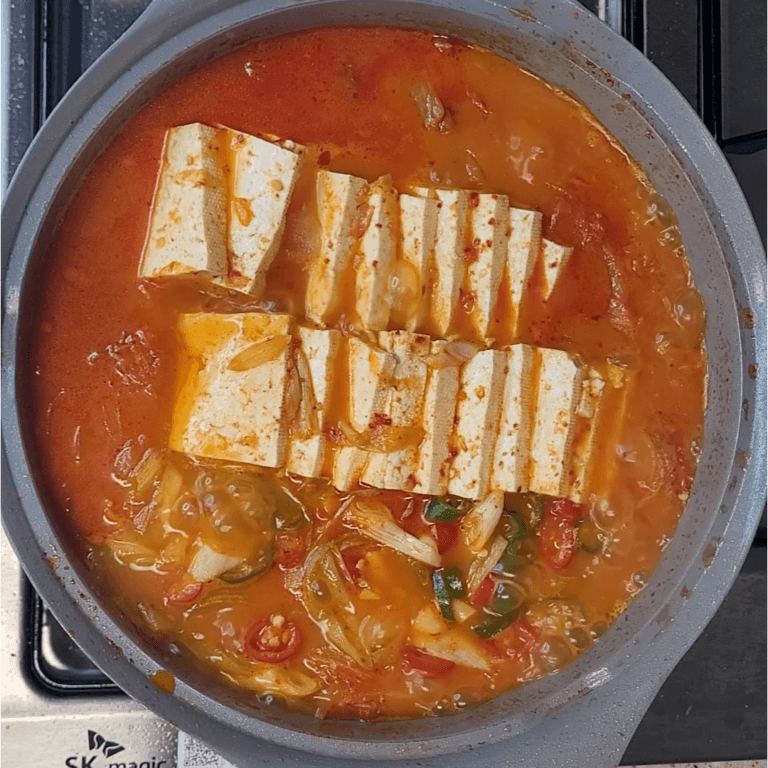
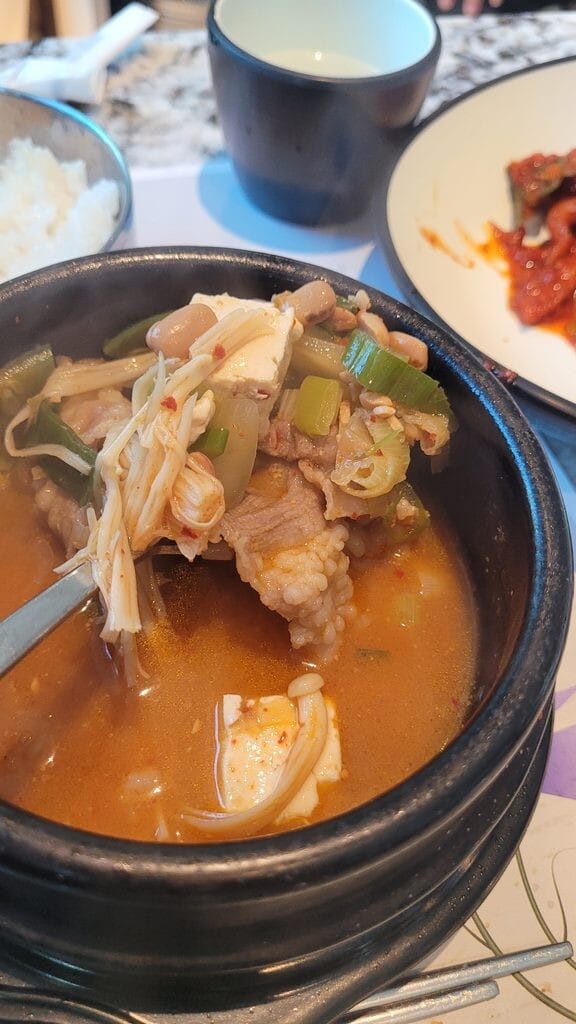
Chadol-doenjang-jjigae (차돌된장찌개 — CHA-dol DWEN-jang JJI-gae), ₩10,000. Soybean paste stew with tofu, enoki, scallion, soybeans and thin-sliced beef brisket. On the nutty side rather than the salty side. Made for pouring over rice.
All three cost ₩9,000–11,000 on their own. All three are included in that ₩21,000.
The side dishes
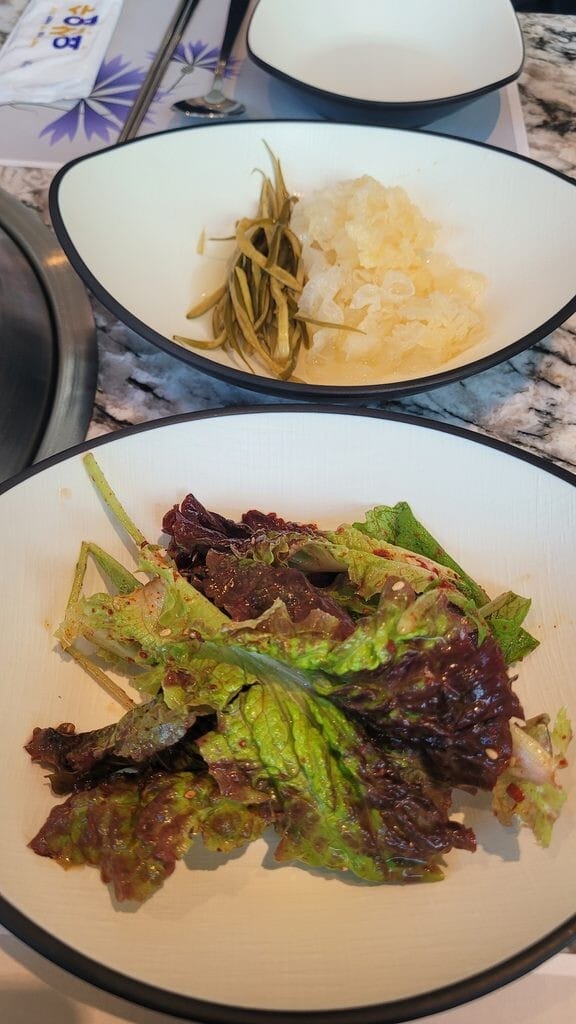
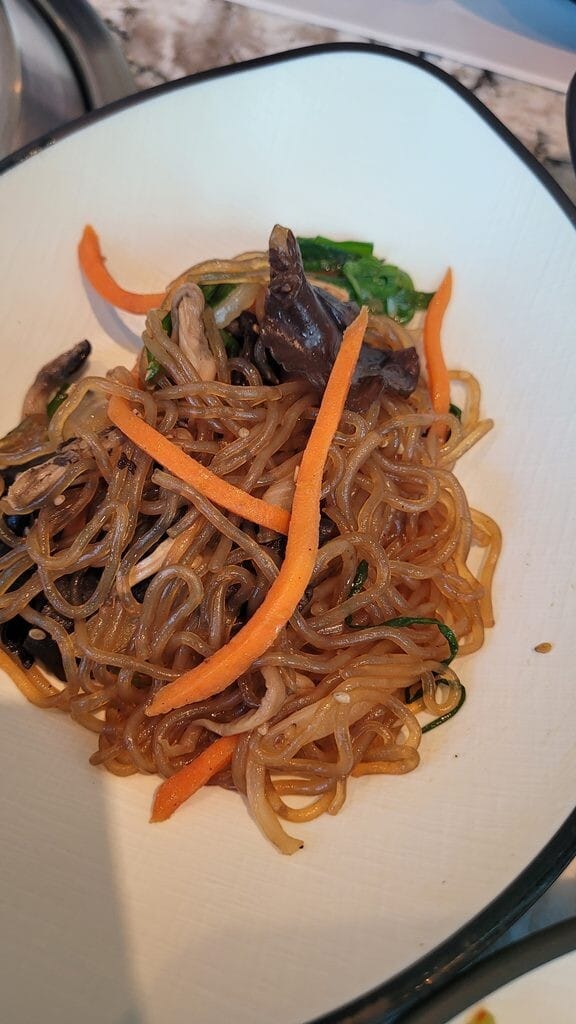
Not showy, but clean: sesame-dressed salad, japchae with wood ear mushroom, soy-pickled onion with chives, dressed lettuce, myeongi mountain garlic leaf, pickled radish, a spicy dressed radish, and cabbage kimchi.
The pickled onion went first. With soy-marinated beef it usually does.
What’s not on the table
Every English-language guide to Korean barbecue tells you to wrap the meat in lettuce with garlic and sauce. Here you can’t.
There are no ssam vegetables. No raw lettuce, no perilla leaves, no green chili, no raw garlic. The lettuce that arrives is already dressed as a salad, which means it can’t be folded around anything.
Ssam (쌈 — SSAM) is the wrap, and for a lot of people it is the entire point of Korean barbecue. I grilled a piece, reached for a leaf, and stopped. The beef was good. That one bite was still missing.
This is unusual for a charcoal galbi house and worth knowing before you sit down. If wrapping matters to you, ask when you order whether they can bring ssam vegetables.
Two more things the menu is honest about, and I’ll be honest about too:
The galbi is American beef. Emperor galbi and the boneless short rib are both USA. The pork shoulder is Chilean. Korean 1++ beef appears only in the premium cuts, which start at ₩49,000. The menu states every origin plainly — nothing is hidden — but if you walked in assuming a Korean galbi house means Korean beef, it doesn’t, and that is part of why the lunch set costs what it costs.
Closed Sundays. And the afternoon break is 3:00–5:00 p.m., two hours rather than the usual ninety minutes. A late lunch does not work here.
Why you’d be in Sangam anyway
Sangam is western Seoul’s broadcasting district — the major networks are headquartered here, along with Seoul World Cup Stadium and Haneul Park. If you’re in the area for any of those, this is a lunch worth planning around.
The restaurant is a designated Good Restaurant (모범음식점), a city hygiene and service certification you’ll see on a plaque by the door.
One more thing, because it made us laugh. There’s a banner out front that reads:
술에갈비? 수레갈비!
It’s a pun. Sul-e galbi — “ribs with drinks” — sounds almost exactly like Surae galbi, the restaurant’s name. Nobody forgets the name after reading it once.
📍 How to get there
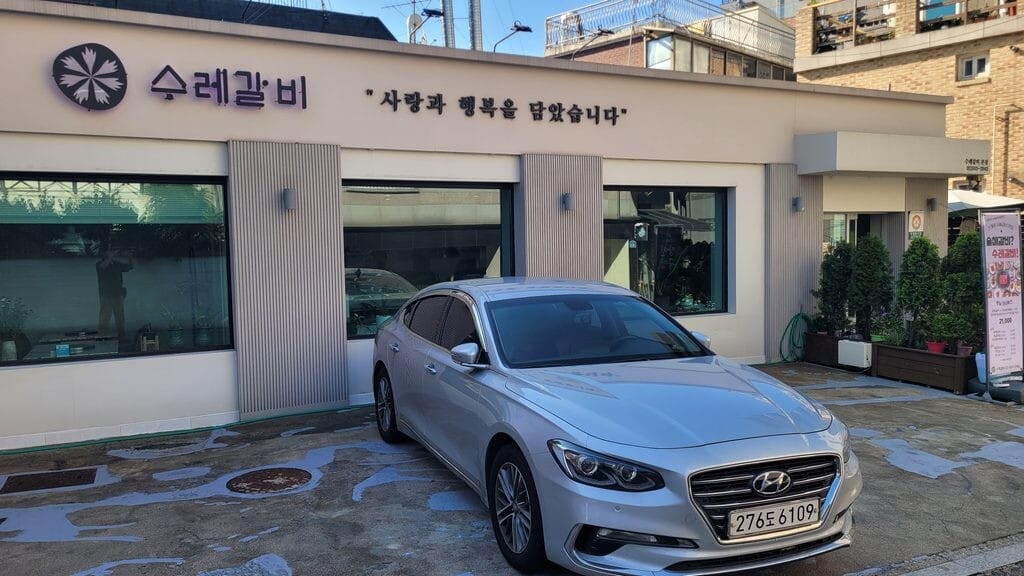
Surae Galbi, main branch · 수레갈비 본점
1F, 19-6 Maebongsan-ro 2-gil, Mapo-gu, Seoul 서울 마포구 매봉산로2길 19-6 1층
Nearest station Digital Media City (Line 6 · Gyeongui–Jungang · AREX), Exit 9 — 300 m, about 4 minutes on foot. The Airport Railroad stops here, so you can come straight from Incheon International Airport without changing trains. Phone +82-507-1309-2942 Hours 11:30–22:00 (last order 20:50) · Break 15:00–17:00 · Closed Sundays Parking In the yard in front, free
Open in Naver Map · Kakao Map · Google Maps
Screenshot the Korean address. Showing it to a taxi driver is faster than trying to pronounce it — and it works even with no signal.
Korean restaurants live on Naver Map and Kakao Map, not Google Maps. Not a knock on Google — Korea only approved the export of detailed map data in early 2026, and coverage is still catching up. The deeper reason is that this is where the data is: Korean restaurants update their hours, break times and holiday closures on Naver, and a place that closed last month shows as closed. Both apps have English versions. If you’re deciding which to install, we compared them here.