A Korean spinach side dish is about as simple as cooking gets. Boil water, drop the spinach in for half a minute, squeeze it out, dress it. Four minutes from start to table.
But every Korean recipe tells you to salt the water, and if you ask why, you’ll get three different answers. I looked them up, and they don’t all survive.
What Koreans say about the salt, and what holds up
“It keeps the green bright.” This one is partly true, and smaller than people think.
What turns blanched greens from bright green to dull olive is acid. Chlorophyll has a magnesium atom at its centre; in acidic conditions the magnesium gets dislodged and hydrogen takes its place, and the result is the yellowish-olive colour of overcooked broccoli. Sodium does offer the chlorophyll molecule some protection — but the effect is minimal, and it is not what’s doing the heavy lifting.
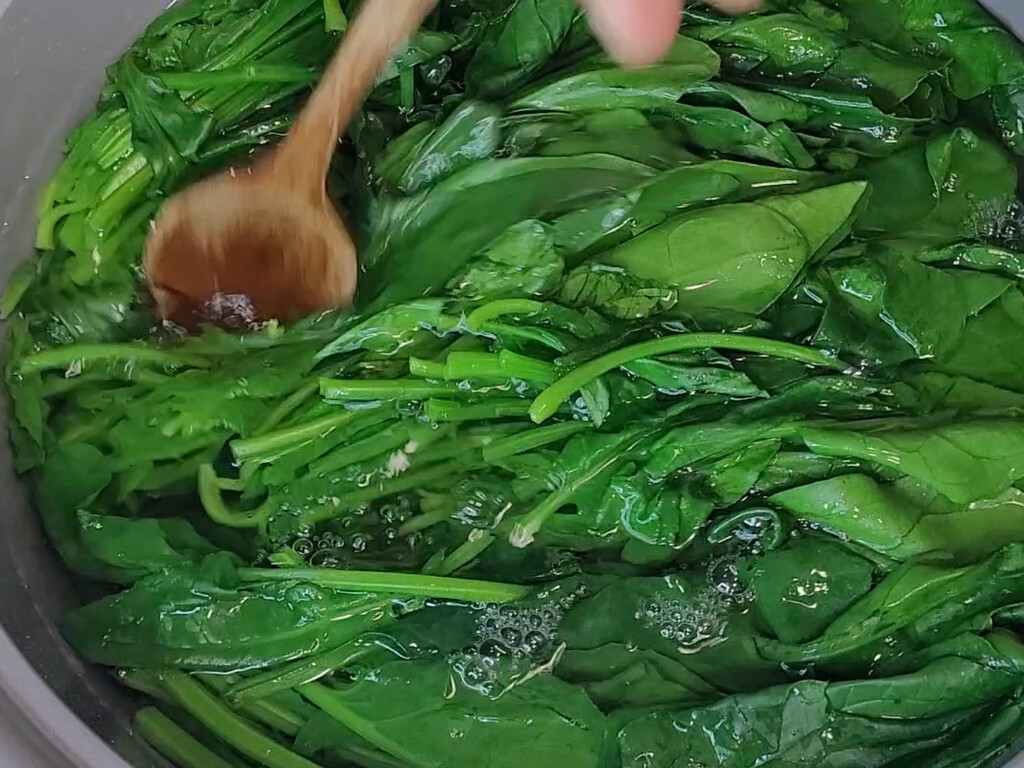
What actually keeps the green: a short blanch, a lot of rapidly boiling water, and a cold rinse straight after. Blanching also brightens colour on its own, by driving the air out of the leaf tissue so you see the real pigment instead of a haze of tiny bubbles.
“It removes the oxalic acid.” Right conclusion. Wrong mechanism, and the salt has nothing to do with it.
Spinach contains oxalic acid, which tastes faintly chalky and binds calcium so your body absorbs less of it. It is often said that boiling makes it evaporate. It doesn’t. Oxalic acid is water-soluble: it dissolves out of the leaf and into the pot, and you pour it down the drain.
That part works well. In a 2019 study published in Food Science and Technology Research, boiling spinach at 100°C for two minutes removed more than half the soluble oxalic acid — 57% and 54% in whole-leaf tests.
But the same study tested salted water directly, and found that adding 1% or 2% salt did not improve oxalate removal at all. At the higher salt concentrations, residual oxalate was actually higher than in plain water. Whatever the salt is doing, this isn’t it.
“Salt raises the boiling point.” Technically true. Practically irrelevant. A spoonful of salt in a large pot raises the boiling point by a fraction of a degree, which changes nothing about how fast spinach cooks.
So what is the salt for?
Seasoning. The spinach absorbs it while it cooks, from the inside, in a way that salt added afterwards can’t replicate.
That matters more here than it would in most dishes, because this one is dressed very lightly — a spoonful of fish sauce, some garlic, a little seasoned salt. There’s nowhere for a bland leaf to hide. Spinach blanched in plain water and dressed afterwards tastes flat, and most people blame the dressing.
Keep salting the water. Just know you’re buying flavour, not chemistry.
Thirty seconds, not two minutes
Here’s the part that complicates the nutrition story, and nobody mentions it.
The study’s 50% oxalate figure comes from a two-minute boil. Korean spinach side dishes blanch for about thirty seconds — long enough to collapse the leaf, short enough to keep some bite and a clean green colour.
Thirty seconds removes less oxalate than two minutes. That’s simply true.
The same study found something else: spinach cut into 1 cm pieces before boiling lost 72% of its oxalic acid, against 54% for whole leaves. More cut surface, more leaching.
Korean practice does the opposite. The spinach goes in whole, comes out whole, and gets cut — if at all — afterwards, because long strands hold the dressing and look right on the plate.
So be clear about what this recipe is optimised for. It’s a texture decision, not a nutrition decision. The oxalate reduction is real but partial, a side effect of a method chosen for how the dish eats. If you wanted maximum oxalate removal you’d chop the spinach first and boil it for two minutes, and you’d end up with something nobody in Korea would recognise.
Why red cabbage gets vinegar instead
The salt-water rule isn’t universal, and the exception explains the principle.
Korean cooks blanch red cabbage in water with vinegar, not salt. The pigment there is anthocyanin, not chlorophyll, and anthocyanin runs the other way: it’s vivid in acid and turns dull blue-grey toward alkaline.
Two vegetables, two opposite instructions, one underlying rule — match the water to the pigment. Green things suffer in acid. Red and purple things need it.
The two seasonings English recipes quietly replace
This recipe uses chamchi-aek (참치액) and matsogeum (맛소금), and most English-language versions of this dish will substitute both without telling you.
Chamchi-aek is tuna-based fish sauce, thinner and less funky than the anchovy kind, with a clean savoury depth. It’s a relatively modern Korean seasoning and it’s in an enormous number of Korean home kitchens. English recipes usually swap in soy sauce, which works but tastes noticeably different — darker, and without the backing note.
Matsogeum is seasoned salt: salt with MSG in it. Korean home cooks use it in vegetable side dishes without a second thought, and the reason recipes written in English leave it out is that it sounds bad in English, not that it isn’t there. We’ve said the same thing about the dashida in our kimchi stew and it’s the same situation.
You can make this with plain salt. It will be slightly flatter, and that’s the honest version.
Shopping notes for the US
Spinach — a Korean market bunch is sold with roots attached and is sturdier than American baby spinach. Mature bunched spinach from any supermarket works. Baby spinach doesn’t — it collapses to nothing in thirty seconds and has no stem to give texture.
Chamchi-aek — Korean markets, usually near the soy sauce in a tall plastic bottle. H Mart carries it. If you can’t find it, use regular fish sauce at about two-thirds the quantity, or soy sauce at the same quantity.
Matsogeum — Korean markets, or make your own with about four parts fine salt to one part MSG. Plain salt is fine.
Daepa — the thick Korean scallion. Two regular US scallions stand in for half a stalk.
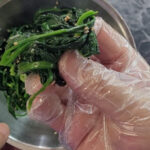
Korean Spinach Side Dish (Sigeumchi Namul)
Ingredients
For blanching
- 1 bunch spinach about 250 g, roots trimmed
- 8 cups water
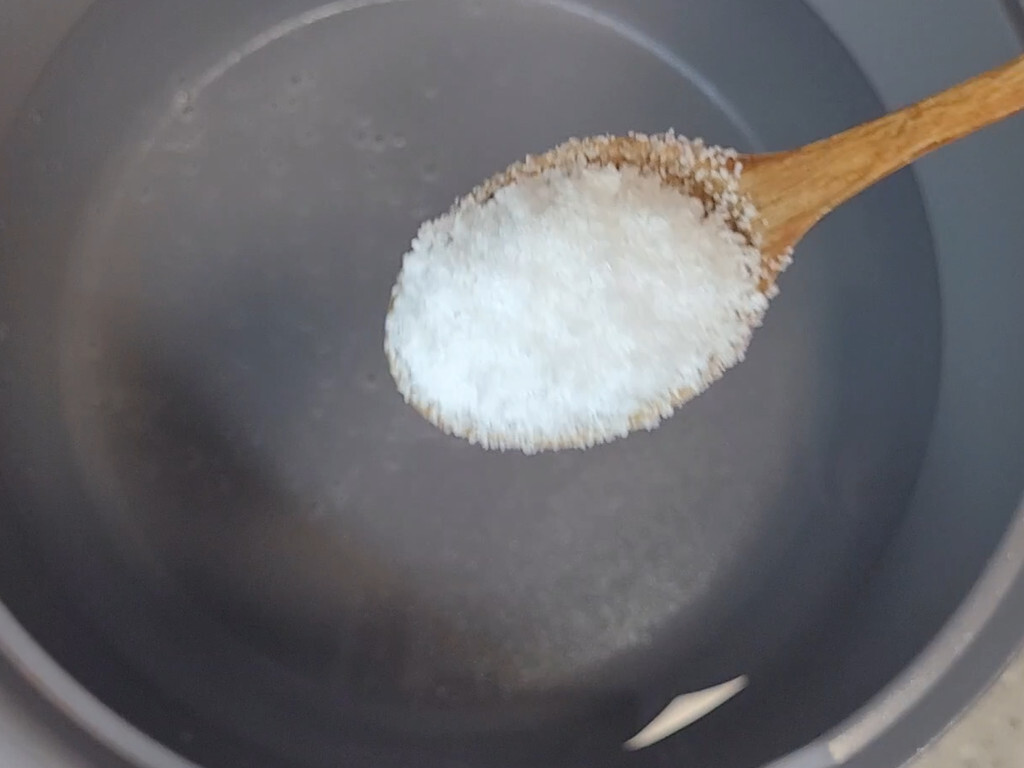
- 1 Tbsp salt
For the dressing
- 2 scallions thinly sliced
- 2 1/4 tsp tuna fish sauce chamchi-aek
- 1 1/2 tsp minced garlic
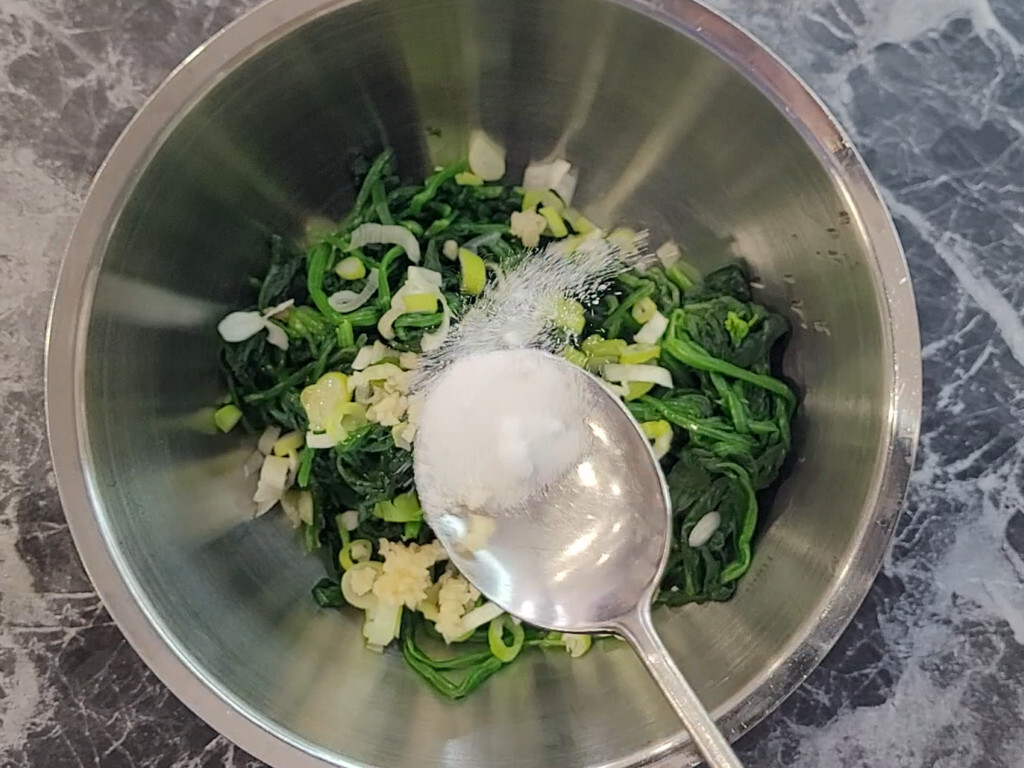
- 2/3 tsp seasoned salt matsogeum
- 1 tsp toasted sesame seeds
Instructions
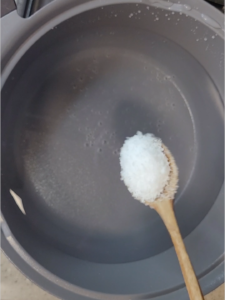
- Bring the water to a rolling boil and add the salt.

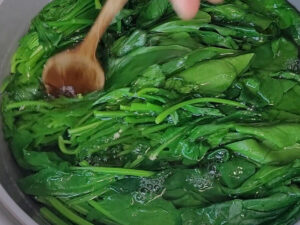
- Add the spinach whole and blanch for 30 seconds. Do not cover the pot.

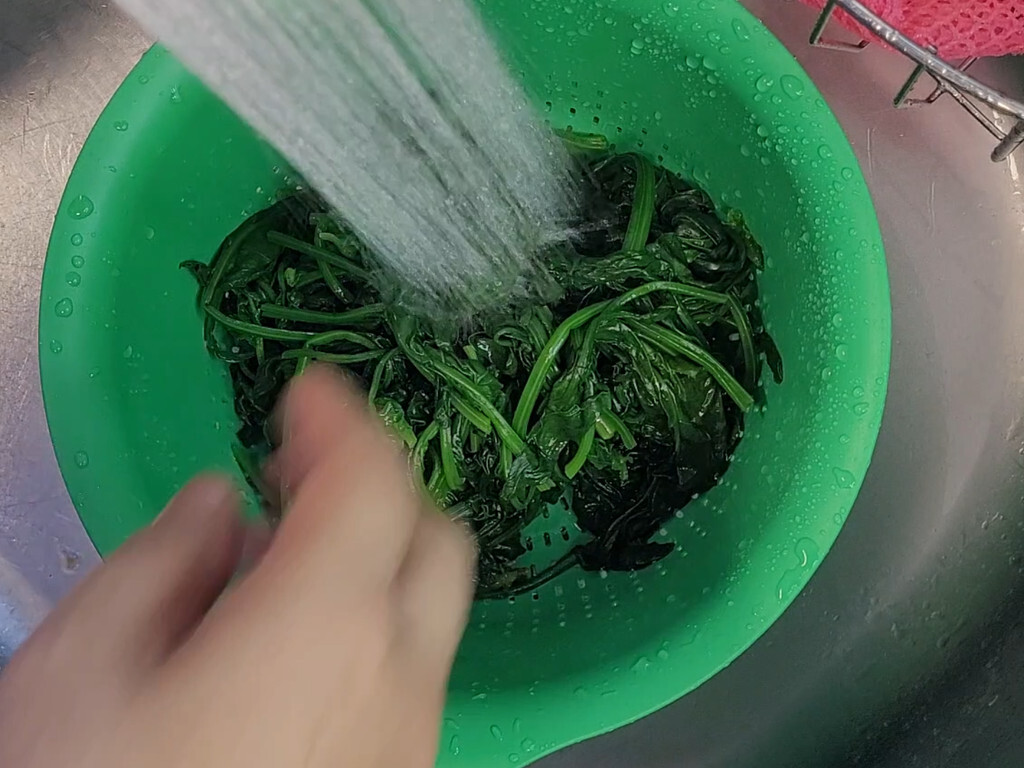
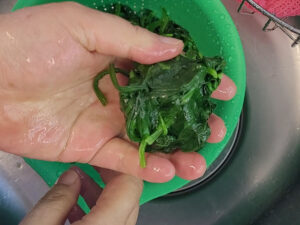
- Lift it out and rinse immediately under cold running water until cool.
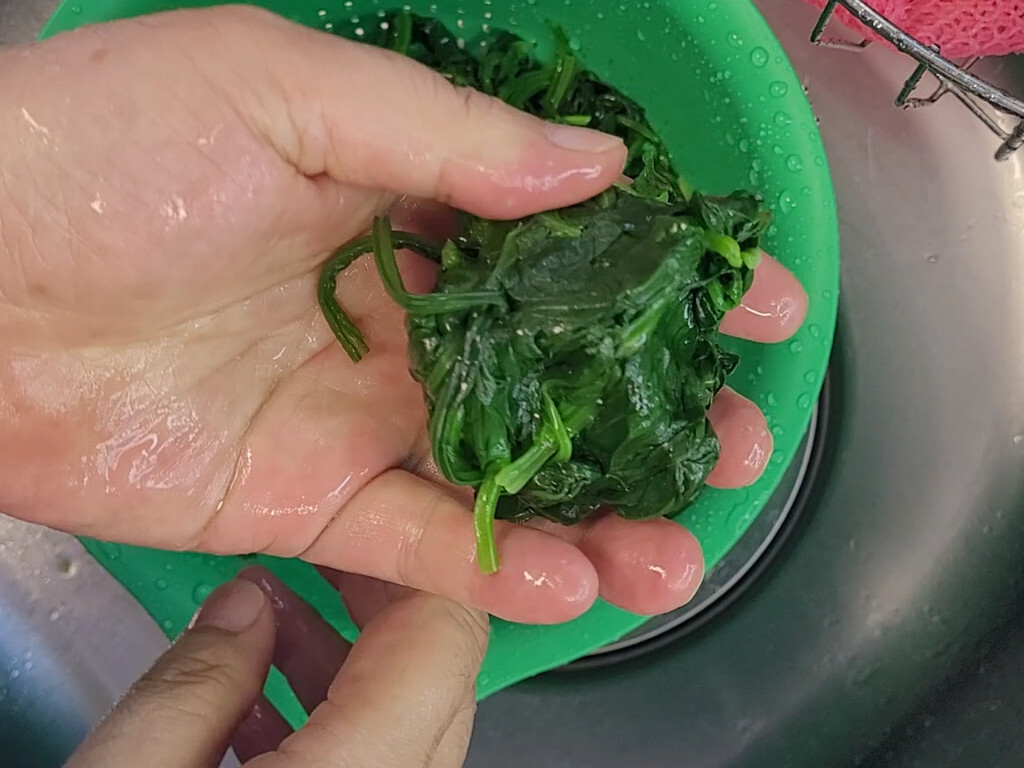
- Squeeze the spinach into a ball until no more water comes out. Squeeze again.
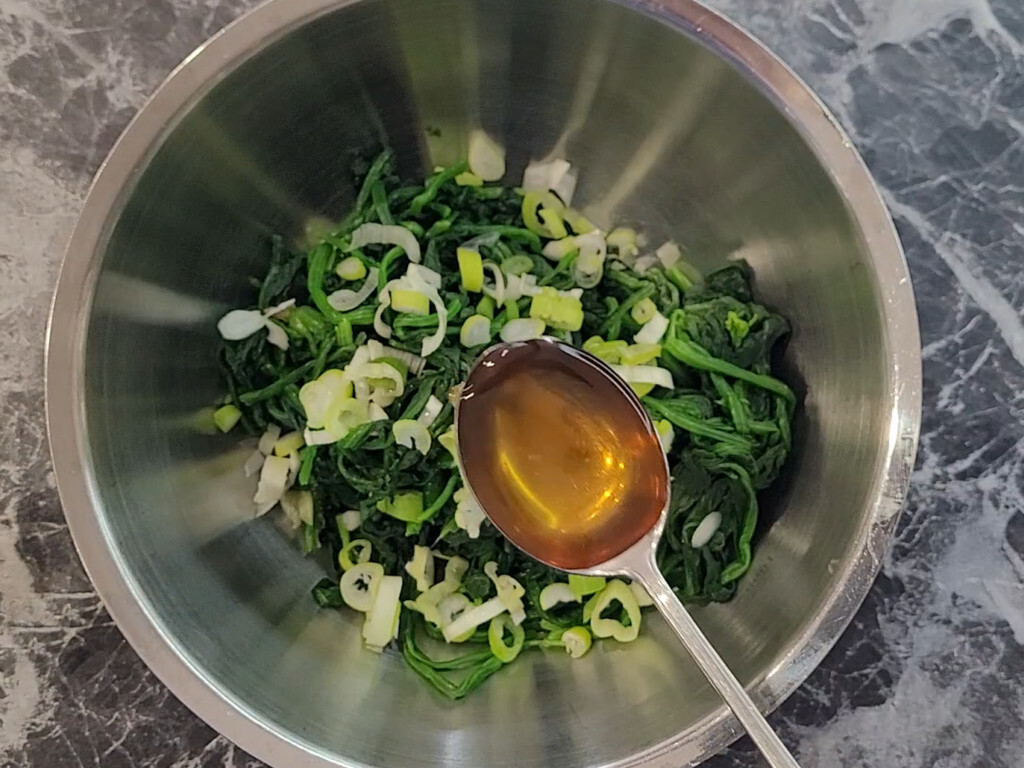
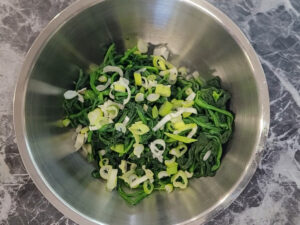
- Loosen the ball into a bowl and add the sliced scallion.
- Add the tuna fish sauce, minced garlic and seasoned salt.
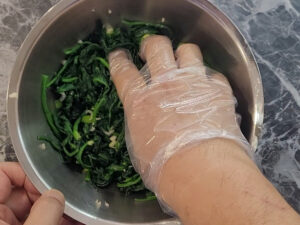
- Mix with your hands until every strand is coated.
- Add the sesame seeds and give it one more turn.



Notes
Where this sits on a Korean table

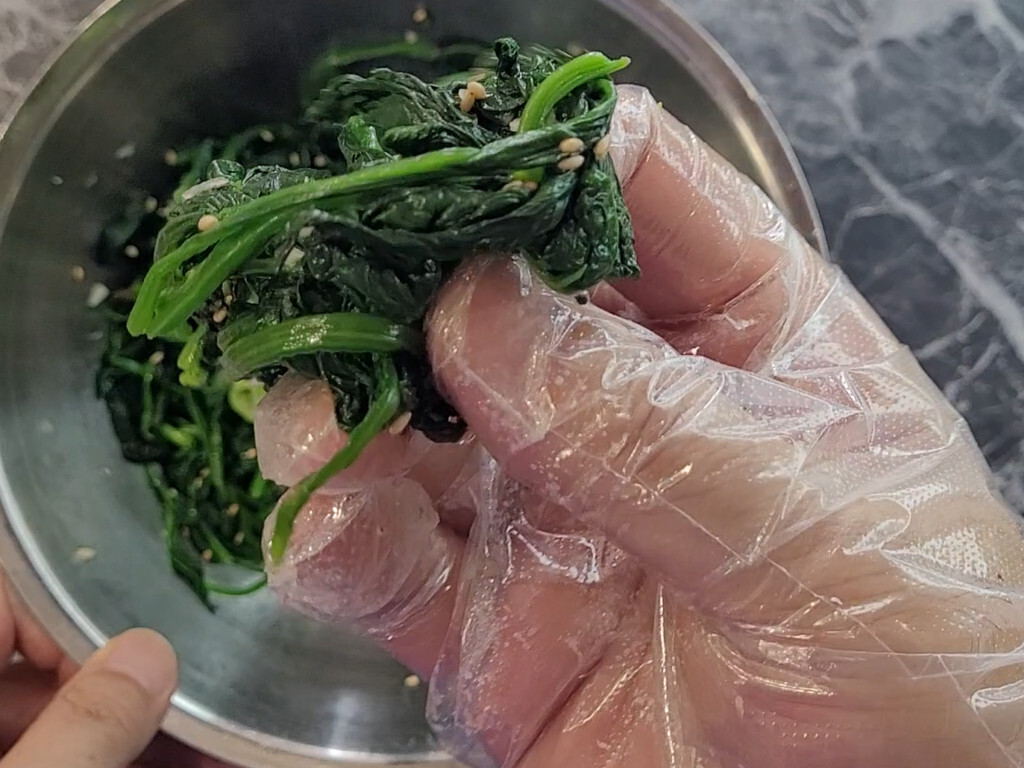
This is banchan — one of the small free dishes that arrive around a Korean meal without being ordered. In a home it goes out alongside rice, soup and two or three other things, and it keeps three or four days in the fridge.
It also belongs to a specific family: namul (나물), vegetables blanched and dressed rather than cooked in sauce. Bean sprouts, bellflower root, bracken, radish greens — same method, different vegetable, and a Korean table usually has two or three at once in deliberately different colours.
If you’ve seen it without knowing the name, it was probably in bibimbap, where blanched spinach is one of the standard strips, or on a hanjeongsik course table, where several namul arrive together near the end with the rice.
What I’d tell you before you make it
Squeeze harder than feels right. Blanched spinach holds a startling amount of water, and any you leave behind dilutes the dressing into a puddle at the bottom of the bowl. Squeeze it into a ball until no more comes out, then squeeze again.
Dress it with your hands. Korean cooks mix namul by hand, and it isn’t ceremony — you can feel when the dressing has reached every strand, which you can’t with a spoon. The word for it, muchida (무치다), means exactly this.
It gets better in the fridge overnight, and it’s better at room temperature than cold. Take it out twenty minutes before you eat.
Don’t walk away from the pot. Thirty seconds is thirty seconds. At ninety you have a different, sadder dish.